The safest place for a boat during a hurricane is off the lift and away from tidal water. That is the consistent advice from BoatUS, whose catastrophe teams have inspected storm damage for decades, and from the Florida Fish and Wildlife Conservation Commission (FWC). If the boat truly has to stay, it needs the drain plug out, heavy straps to the lift and dock, and every piece of canvas off. And all of it has to be finished before tropical-storm-force winds arrive, which is often well before landfall.
This guide covers boat lift hurricane preparation from the start of the season to the day after the storm: a timeline keyed to National Hurricane Center (NHC) products, a five-minute measurement that tells you whether storm surge will reach your hull, the places where expert sources genuinely disagree, and a post-storm inspection that keeps you from energizing a flooded lift. It is written for Florida and Gulf Coast docks, but the steps apply anywhere a lift sits in tidal water.
One note before you start: your own safety, and your family's, comes before any of this. If an evacuation order covers your address, the boat waits.
Should you leave your boat on the lift during a hurricane?
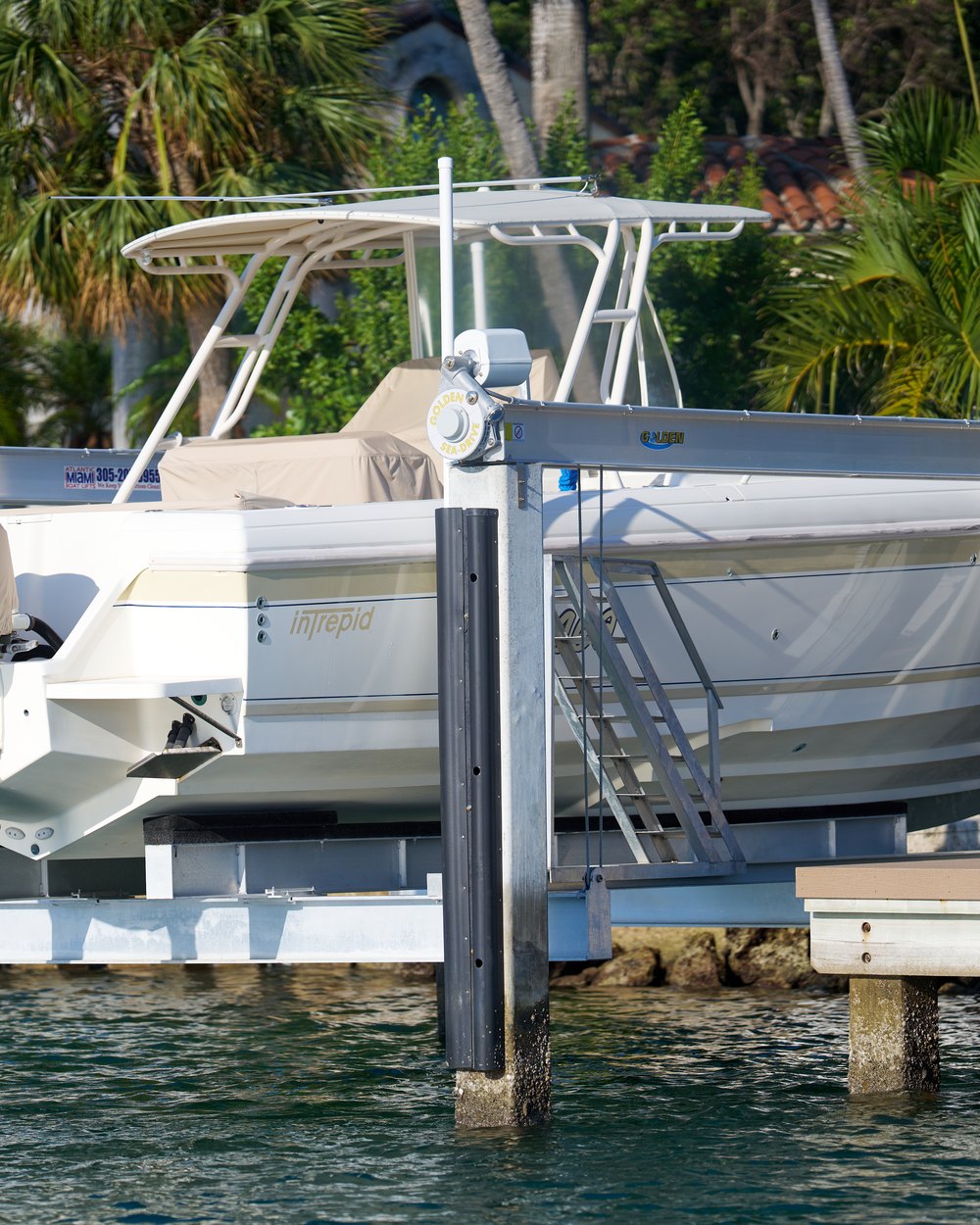
Not if you can avoid it. In its hurricane preparation guide, BoatUS asks whether any boats on lifts have survived in hard-hit areas and answers: "not many." The damage it describes includes boats blown off cradles, bunk boards breaking and spilling boats, boats grinding against lift motors and pilings, boats overcome by storm surge, and boats filling with rainwater until the lift collapsed. The few that survived "were typically subjected to only a slight surge, and the lift had been secured so that the boat and its cradle couldn't be tossed around by the wind."
FWC's short version is "Move your vessel if you can and protect it if you can't," and it specifically includes kayaks and other small craft in the advice to trailer out and move away from tidal waters.
So the order of preference looks like this:
- Haul out and store ashore, well above the surge you could see, ideally at a facility outside your evacuation zone.
- Trailer it inland if the boat is trailerable.
- Leave it on the lift only as a last resort, and then follow the "if it has to stay" steps below exactly.
If hauling out is your plan, arrange it with the yard before the season, and ask what triggers their storm haul-outs. Trying to find a slot when the cone is already over your county is the hard way.
Will storm surge reach your boat? The five-minute measurement
Here is the step almost no hurricane checklist includes, and it is the one that decides whether leaving the boat on the lift is even a reasonable gamble.
The NHC states its storm surge forecasts as height above normally dry ground, not above sea level or the tide line. Its Peak Storm Surge Forecast values "represent the height that water could reach above normally dry ground somewhere within the specified areas." That means you can compare the forecast directly against a number you measure in your own yard.
How do you find your clearance number?
- Raise the lift to its full height, with the boat on it.
- Find the normally dry ground nearest the lift. On most canal lots this is the yard right behind the seawall.
- Measure straight up from that ground level to the lowest point of the hull. Write the number down and keep it with your hurricane plan.
How do you use it when a storm is coming?
When a storm threatens, the NHC publishes two surge products worth checking: the Peak Storm Surge Forecast (a range for each stretch of coast) and the Potential Storm Surge Flooding Map, which NHC describes as a "reasonable worst-case scenario" with only a 10 percent chance of being exceeded at any location. Compare the top of the forecast range for your area against your clearance number.
- If the top of the range is at or above your clearance, the surge can reach the hull. Moving the boat is no longer optional.
- If the top of the range is close to your clearance, treat it the same way. The National Weather Service notes that its surge figures do not include waves on top of the surge, and the forecast is the height reached "somewhere" in the zone, not a guarantee for your lot.
- If your clearance is comfortably above the forecast, surge is less likely to reach the hull, but wind and rainwater are still working on the boat and the lift.
For scale: NHC's report on Hurricane Ian (2022) recorded peak storm surge inundation of 10 to 15 feet above ground level in Fort Myers Beach. Measure your clearance and compare it to that number.
The boat lift hurricane preparation timeline
The NHC issues a hurricane watch 48 hours before the anticipated onset of tropical-storm-force winds, and a hurricane warning 36 hours before. Storm surge watches and warnings follow the same 48 and 36 hour pattern. Notice what those clocks count down to: the arrival of tropical-storm-force winds (39 mph and up), not landfall. Once those winds arrive, working on a dock or ladder is dangerous. The NHC's "Earliest Reasonable Arrival Time of Tropical-Storm-Force Winds" graphic shows the time before which there is no more than a 1 in 10 chance of those winds starting at your location, which NHC calls the period when preparations "should ideally be completed." Use that time, not landfall, as your deadline.
Before the season starts (by June 1)
- Call your insurer. Ask how the policy treats a boat on a lift during a named storm, whether a written hurricane plan is required, and whether haul-out costs are reimbursed. BoatUS Marine Insurance, for example, covers 50 percent of the cost (up to $1,000 per event) to professionally haul, move or protect an insured boat ahead of a NOAA named storm. Other policies differ, so get your own answer in writing.
- Book a haul-out or storage plan and confirm the yard's trigger (some move boats at a watch, some on a first-come basis).
- Know your evacuation zone at floridadisaster.org/knowyourzone. If you are in Zone A, assume you will be leaving early.
- Measure your clearance number as described above.
- Photograph and document the lift, boat, motor, remote and serial plates from several angles. Store copies off-site or in the cloud.
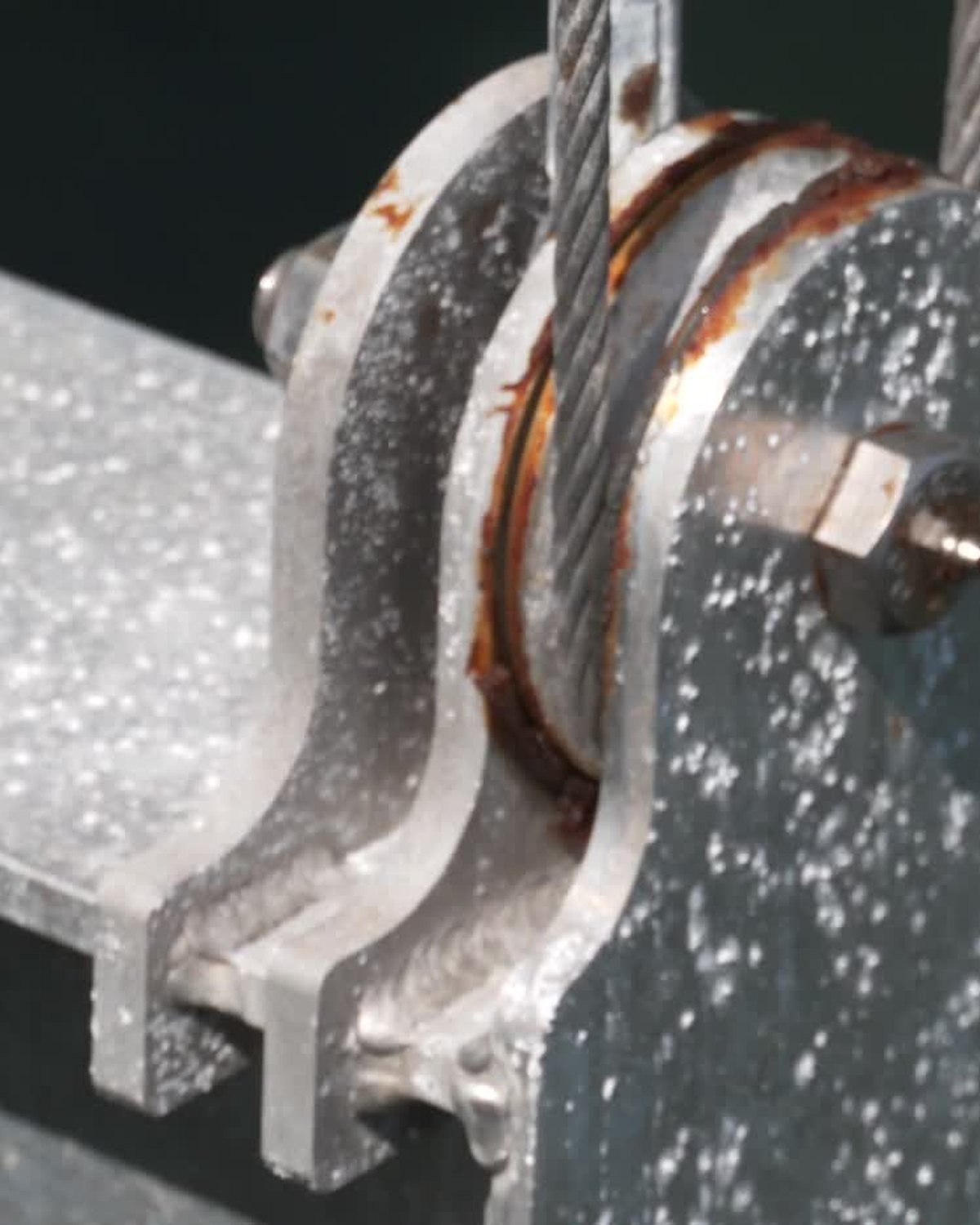
- Run the lift through a full cycle and inspect it. Look at cables for broken wires, kinks or rust at the end fittings, check sheaves turn freely, and test the GFCI. A lift that struggles in June will not cooperate in a storm scramble. Worn cables are far easier to replace now; see our cables and rigging parts, matched to your lift's specified diameter.
- Buy straps and lines now, before a storm is named: heavy ratchet straps rated well above the job, plus spare dock lines.
- Get your manufacturer's storm instructions for your exact lift model, including how it should be left when empty. More on that below.
About 5 days out: your area is in or near the cone
- Start checking each full NHC advisory and the arrival-time graphic.
- Call the haul-out yard or storage facility and confirm your slot.
- If you will trailer, check the trailer: tires, bearings, lights, straps.
- Plan your route and your timing. Do not count on a last-minute run by water or road once evacuations begin.
About 72 hours out
- Move the boat if that is the plan. This is the comfortable window, before watches go up and every yard and ramp is busy.
- Bring kayaks, paddleboards and anything stored on racks or a kayak launch inside.
- Strip the boat if it is staying: biminis, enclosures, cushions, electronics, life jackets, EPIRBs and loose gear.
48 hours out: hurricane watch
- If the boat must stay on the lift, set it up now (see the next section).
- Remove the lift canopy fabric. A canopy is a sail mounted on top of the lift.
- Remove or secure everything else on the dock: deck boxes, hoses, chairs, ladders.
- Bring wireless remote transmitters inside.
36 hours out: hurricane warning
- Position first, power second. The lift needs power to move, so run it to its final storm position before you shut anything off. A common mistake is killing the breaker and then realizing the cradle is in the wrong place.
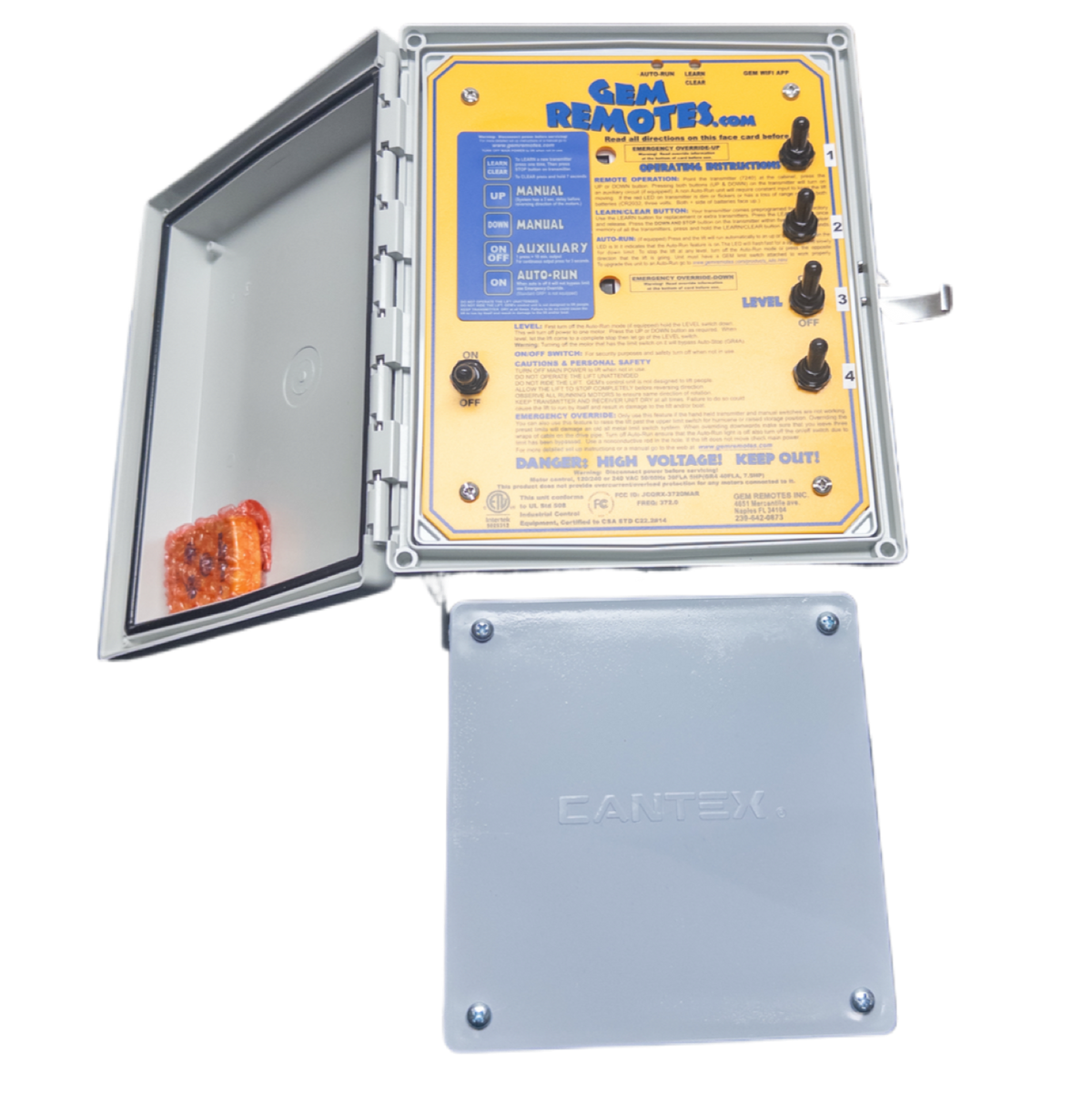
- Then shut off the lift circuit at the breaker, not only at the dock switch.
- Re-check straps and lines, take final photos, and leave the dock. FWC is blunt about this: do not stay aboard, and do not venture out once conditions deteriorate.
If the boat has to stay on the lift, what should you do?
BoatUS gives specific instructions for this case, and they are worth following to the letter:
- Remove the drain plug. BoatUS says to do this "so the weight of accumulated rainwater will not collapse the lift." It adds that if the surge reaches the boat it will flood either way, but leaving the plug in "is likely to result in more serious structural damage." A hurricane can drop many inches of rain into an open cockpit, and that water weight goes straight onto the cables, sheaves and beams.
- Tie the boat securely to the lifting machinery "to prevent the boat from swinging or drifting away." BoatUS also reports that some boats survived when owners used heavy straps to attach them to well-secured cleats on the dock.
- Keep cockpit drains clear of leaves and debris so rain can leave.
- Plug the engine exhaust outlet and strip the boat of everything removable.
- Take off the lift canopy and any boat canvas that can come off, to cut the wind load.
A strap is only as good as what it is tied to. Use cleats and pilings that are through-bolted and sound, not a cleat screwed into a deck board.
Where do the experts disagree?
Hurricane advice is not perfectly uniform. These are the real points of disagreement we found.
Raise or lower an empty lift?
There is no universal answer. We could not find a manufacturer-wide rule, and lift designs differ (cable cradle lifts, elevator lifts, floating lifts and hydraulic lifts behave very differently in surge). One Florida lift contractor tells clients to lower lifts all the way down before major winds. At least one cradle lift maker describes a design that raises the cradle tight against the top of the lift so it cannot sway. The trade-off is real: a cradle left high stays out of moderate surge and floating debris but catches more wind, while a cradle left low is more exposed to surge and debris. Get the written storm position for your exact model from its manufacturer or installer before the season, and follow it.
Boat cover on or off?
FWC advises removing canvas coverings where possible to reduce wind load. One edition of the BoatUS guide notes that boats that survived on lifts had often been covered to keep rainwater weight down. Both points are about load. A loose, flapping cover will tear free and add windage, while a tight, well-secured cover on a boat with the plug out and drains clear sheds rain. If you cannot make a cover drum-tight and fully secured, take it off and rely on the open drain plug.
How do you inspect a boat lift after a hurricane?
Return only when local officials say it is safe. Then work in this order.
1. Document before you touch anything
Photograph and video the lift, the boat, the dock, the pilings and the electrical equipment from several angles before you move, cut or clean anything. Your insurer will want to see the damage as the storm left it.
2. Treat all electrical equipment as damaged until proven otherwise
Leave the breaker off. If surge or flood water reached the motor, switch, GFCI, remote receiver or wiring, do not simply let it dry and switch it back on. NEMA's guidance on water-damaged electrical equipment says GFCIs and other wiring devices that were exposed to water should be replaced, warns that water can leave contaminants inside devices that cause problems later, and says flooded motors need evaluation by qualified people because insulation and internal components can be damaged. Salt water makes this worse, not better. This is the moment to bring in a licensed electrician.
If parts need replacing, we carry switches and electrical components, remotes and receivers and boat lift motors. Fit varies by lift and motor type, so check your existing part's markings first or use our fit help page.
3. Inspect the structure and rigging
- Pilings: any lean, movement, cracking, or loose mounting brackets.
- Beams and cradle: bends, twists or cracked welds.
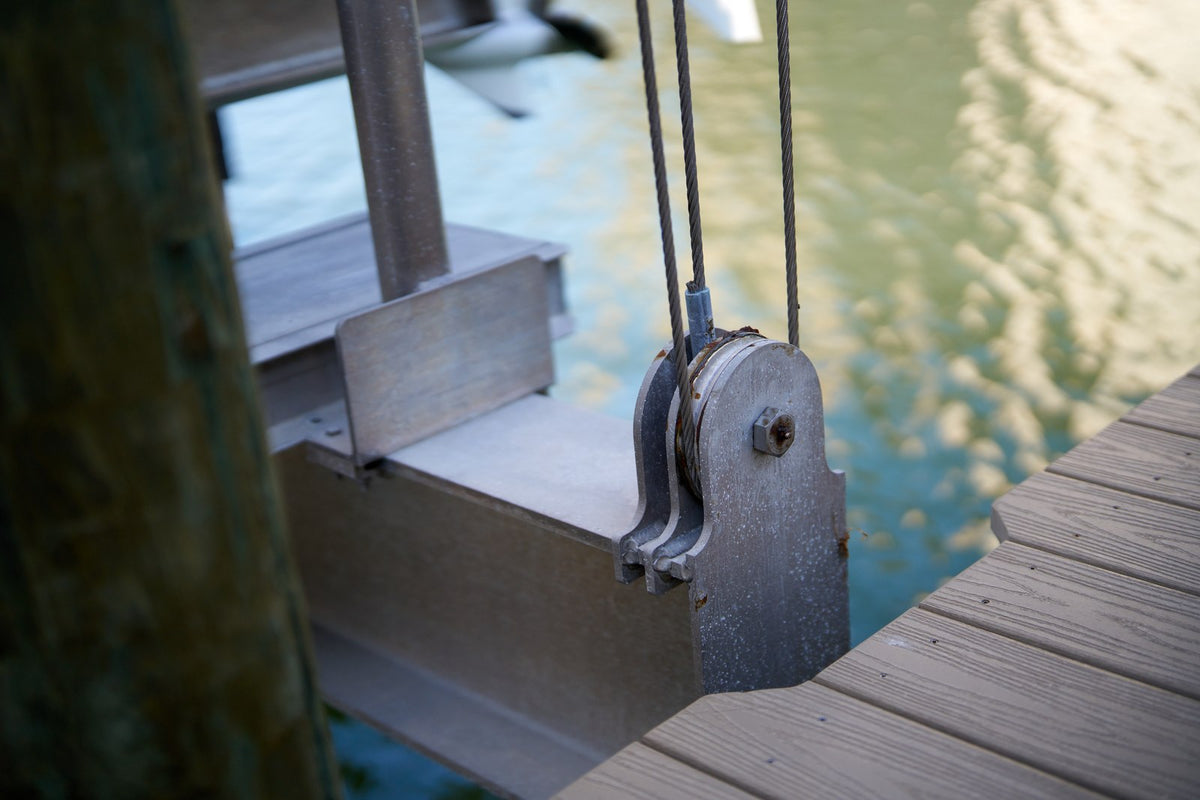
- Cables: kinks, crushed sections, birdcaging, broken wires, and damaged end fittings. Wire rope industry guidance treats any kink or birdcage as a reason to replace.
- Sheaves and pulleys: wobble, cracked flanges, or a cable that has jumped the groove.
- Bunks and bunk brackets: cracked boards, loose bolts, torn carpet.
- Debris: anything wedged in the cradle or wrapped around cables.
4. Rinse everything with fresh water
Surge leaves salt and silt on parts that normally stay dry, such as the motor, gearbox, drive and the underside of the top beams. Rinse them with fresh water as soon as it is safe to do so.
Only after the electrical system and structure have been cleared should the lift be cycled, and then empty first.
If your boat ended up somewhere else
Report storm-damaged boats that may be lost or abandoned to local law enforcement or to the FWC Division of Law Enforcement at 888-404-3922. After Hurricane Ian, FWC gave owners of derelict vessels 45 days from the day the storm passed to remove them or bring them into non-derelict condition. That window was specific to Ian, so check FWC's notice for the storm that hit you.
When should you call a professional?
Most of the preparation steps above are owner work. These are not:
- Any electrical equipment that was submerged. Call a licensed electrician. Dock wiring has its own article of the National Electrical Code (Article 555), which requires GFCI protection for boat hoist outlets on circuits up to 240 volts.
- Pilings that moved or brackets that pulled. A marine contractor has the equipment and experience to judge whether a piling can be reused.
- A bent beam, cracked weld or twisted cradle. Bring in your lift installer or a marine contractor before you put weight on it again.
- A boat that ended up in the water or on a neighbor's dock. Call your insurer first, then a licensed salvage company.
Local marine contractors are stretched thin after a storm. Owners who already have a relationship with one tend to get on the schedule sooner, which is one more reason to make that call before the season starts.
Your one-page boat lift hurricane checklist
| When | What to do |
|---|---|
| Before June 1 | Insurer call, haul-out booking, know your zone, measure clearance, photos, full lift inspection, buy straps, get manufacturer storm instructions |
| About 5 days out | Watch NHC advisories and arrival-time graphic, confirm haul-out slot, check trailer, plan route |
| About 72 hours out | Move the boat, bring small craft inside, strip the boat |
| 48 hours (watch) | If the boat stays: plug out, straps, drains clear. Remove lift canopy, clear the dock, bring remotes in |
| 36 hours (warning) | Run the lift to its storm position, then shut off the breaker, final photos, leave |
| After the storm | Wait for the all-clear, photograph, keep power off, electrician for anything flooded, inspect structure and cables, rinse with fresh water |
Once the season is over, the same salt that surge leaves behind is working on your lift every week. Our guide to how long boat lifts last in salt water covers the part-by-part maintenance that keeps a lift ready for the next storm.
Frequently Asked Questions
Should I leave my boat on the lift during a hurricane?
Only if you have no other option. BoatUS reports that few boats on lifts survive in hard-hit areas, and both BoatUS and FWC recommend moving the boat ashore and away from tidal water whenever possible. If it must stay, remove the drain plug, strap the boat to the lift and to well-secured dock cleats, keep the cockpit drains clear, and take off all canvas.
Should I raise or lower an empty boat lift before a hurricane?
There is no universal rule. Lift designs differ, and so does the advice: some contractors lower lifts fully, while at least one cradle lift maker designs its cradle to raise tight against the top of the lift so it cannot sway. Get the written storm position for your exact lift model from its manufacturer or installer before the season starts.
Should I take the drain plug out of a boat left on a lift?
Yes. BoatUS advises removing the drain plug on a boat left on a lift so the weight of accumulated rainwater does not collapse the lift. If storm surge reaches the boat it will flood either way, but BoatUS says leaving the plug in is likely to cause more serious structural damage.
When should I finish preparing my boat lift for a hurricane?
Before tropical-storm-force winds arrive, not before landfall. The National Hurricane Center issues hurricane watches 48 hours and warnings 36 hours ahead of those winds, and its Earliest Reasonable Arrival Time graphic shows when preparations should ideally be complete at your location.
Can I use my boat lift after it was underwater in storm surge?
Not until it has been checked. Keep the breaker off, and have a licensed electrician evaluate the motor, switch and wiring. NEMA guidance says GFCIs and wiring devices exposed to flood water should be replaced and flooded motors should be evaluated by qualified people. Inspect the cables, sheaves and structure before cycling the lift empty.
Does insurance pay to haul my boat out before a hurricane?
Some policies do. BoatUS Marine Insurance, for example, reimburses 50 percent of the cost, up to $1,000 per event, to professionally haul, move or protect an insured boat ahead of a NOAA named storm. Coverage varies by insurer and policy, so ask yours before the season starts.
Sources
- BoatUS, Guide to Preparing Boats and Marinas for Hurricanes: https://www.boatus.com/hurricanes/assets/pdf/HurricaneWarning.pdf
- BoatUS, Hurricane Preparation Guide (boats on lifts, covers): https://boatus.geico.com/documents/boat-hurricane-prep-guide.pdf
- BoatUS Marine Insurance, Claims Information (named storm haul-out coverage): https://www.boatus.com/products-and-services/boat-insurance/claims-information
- FWC, Storm Prep Resources: https://myfwc.com/boating/safety-education/hurricane/
- FWC, vessel owners storm preparation notice: https://myfwc.com/news/all-news/storm-boat-124/
- FWC, Hurricane Ian displaced vessel hotline and 45-day notice: https://myfwc.com/news/all-news/boat-hotline-1022/
- National Hurricane Center, Glossary (watch and warning definitions): https://www.nhc.noaa.gov/aboutgloss.shtml
- National Hurricane Center, Storm Surge Products: https://www.nhc.noaa.gov/surge/products.php
- National Hurricane Center, Arrival of Tropical-Storm-Force Winds graphics: https://www.nhc.noaa.gov/arrivaltimes/
- National Hurricane Center, Tropical Cyclone Report, Hurricane Ian: https://www.nhc.noaa.gov/data/tcr/AL092022_Ian.pdf
- National Weather Service Wilmington, Hurricanes 101 (surge forecasts exclude waves): https://www.weather.gov/media/ilm/2026_Hurricanes101.pdf
- Florida Division of Emergency Management, Know Your Zone: https://www.floridadisaster.org/knowyourzone/
- NEMA, Evaluating Water-Damaged Electrical Equipment: https://ieci.org/wp-content/uploads/2026/07/NEMA-CS-70006-2026-Evaluating-Water-Damaged-Electrical-Equipment-GD-1.pdf
- Union Rope, When to Replace Your Ropes (wire rope removal criteria): https://www.unionrope.com/Portals/0/Documents/Technical/Crane/when-to-replace.pdf
- Coastal Marine Group, boat lift services (contractor advice to lower lifts, single source): https://coastalmarinegroup.net/services/boat-lifts
- ShoreStation, permanent boat lifts (cradle raised to eliminate sway, design description): https://www.shorestation.com/boatlifts/permanent
- Mike Holt, Marinas and Docks, NEC Article 555 summary: https://www.mikeholt.com/files/PDF/FREE_PDF_Marinas_and_Docks_2023.pdf

Leave a comment
This site is protected by hCaptcha and the hCaptcha Privacy Policy and Terms of Service apply.