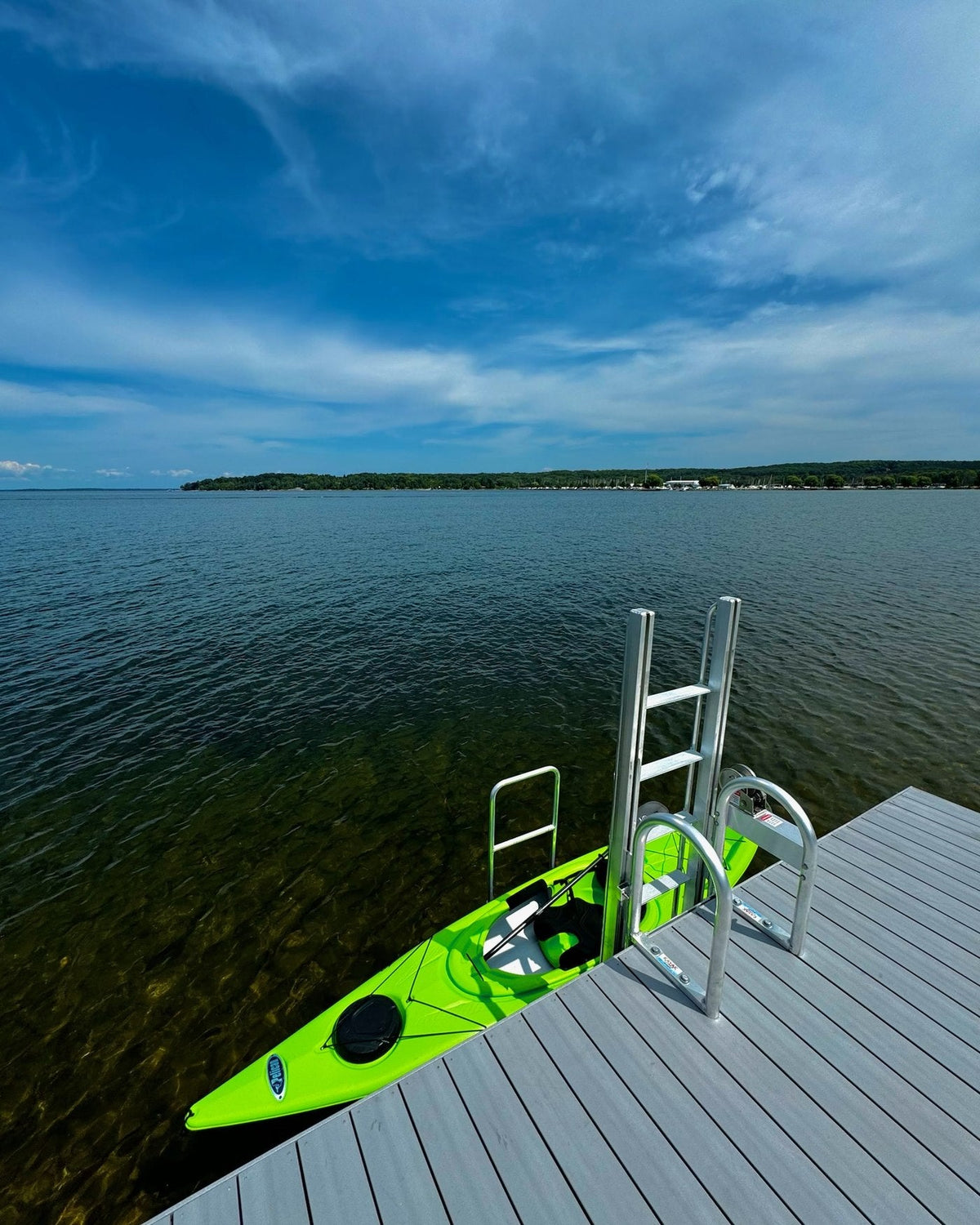
Quick answer: For a fixed dock or seawall up to 32 inches above the water at low tide, a dock-mounted Kayak Launch lowers your kayak to the waterline with a hand winch, and you board from its steps holding a grab rail. Dock height picks the step count (up to 16 in: 3 Step; 16 to 24 in: 5 Step; 24 to 32 in: 7 Step). Kayak width picks the frame (43 in clear entry on Standard, 56 in on Heavy Duty, which comes in 5 and 7 Step). Prices start at $2,795 with freight included.
There's a moment every dock-owning paddler recognizes. You're standing at the water's edge at 6:30 a.m., kayak balanced on the seawall, trying to lower it in without scratching the hull or blowing out your lower back, again. The sun is perfect. Your coffee is getting cold on the dock. And you're wondering why getting into the water from your own property is this hard.
A kayak launch system for your dock is the permanent fix. Not pool noodles. Not a DIY plywood ramp. Not asking the neighbor. A dock-mounted mechanical system that lowers your kayak, canoe, or paddle board into the water and retrieves it: solo, every time, without drama.
This guide covers every category of dock kayak launch solution on the market: what separates them, what the buying criteria actually are, which questions to ask about your specific dock, and why the Kayak Launch is the product we recommend. If you're ready to stop improvising and solve this correctly, start here.
What Is a Kayak Launch System for a Dock?
A kayak launch system for a dock is a dock- or seawall-mounted mechanical device that lowers a kayak, canoe, or SUP from dock level to water level (and raises it back up) without manual lifting. The paddler positions the vessel in the launch frame, operates the lift mechanism, and the boat moves vertically under mechanical control.
The best systems eliminate manual lifting entirely. You don't hoist the kayak over a railing. You don't drag it down a ramp. You set the empty kayak in the cradle, lower it from the dock, then climb down the steps and get in while the bunks hold it steady at the waterline.
Who Actually Needs a Dock Kayak Launch (and Who Doesn't)
This product isn't for everyone. Here's an honest assessment.
You need a dock kayak launch if: - Your fixed dock or seawall sits well above the water at low tide (the Kayak Launch covers docks up to about 32" at low tide) - You paddle solo (no one else to spot you or help lower the hull) - You're paddling a kayak over 50 lbs (touring kayaks, sit-on-tops, and fishing kayaks often run 65 to 90 lbs; tandem kayaks can hit 100+ lbs) - You've had a close call: a slipped grip, a scraped hull, a strained back - You want to paddle on your schedule, not when conditions or helpers align
You might not need one if: - Your dock is floating and sits at or near water level year-round - You paddle a lightweight rec kayak (under 40 lbs) and your dock height is under 12" - You have a natural shoreline launch next to your dock and don't mind carrying to it - Your dock or seawall sits more than about 32" above the water at low tide: that is beyond the standard Kayak Launch models and a custom build conversation
Most waterfront homeowners with fixed docks, seawalls, or elevated floating docks (particularly on coastal inlets, bays, and canals) fall squarely into the "needs this" category. If you've rigged up any kind of workaround to get your kayak in the water, you already know the answer.
The 4 Types of Dock Kayak Launch Solutions
The market for dock kayak launch solutions is smaller and more fragmented than most buyers expect. Here's a plain-language breakdown of what exists and what each type actually does.
1. Mechanical Dock Lift Systems
What it is: A frame mounted to the dock or seawall with a winch mechanism that vertically lowers and raises the vessel. The paddler operates the winch (usually hand-cranked) and the boat moves under controlled mechanical force.
What it does well: Full vertical travel. Works on fixed docks and seawalls within each model's dock-height range. Handles heavier vessels (250 to 350 lbs). No power required. Dock-to-water and back.
What to watch: These are purpose-engineered products. Quality matters: cheap cable hardware corrodes fast in saltwater. Look for marine-grade aluminum frames, stainless steel hardware, and a manufacturer with a track record.
Our recommendation: This is the only category we sell in, because it's the only category that actually solves the problem long-term. The Kayak Launch is the benchmark product in this type.
2. Paddle-Assist and Launch Arms
What it is: A bracket or arm that extends from the dock edge, providing a pivot point or assist for manual lowering. The paddler still does most of the physical work; the arm reduces awkward angles and provides a handhold.
What it does well: Lower price point. Simple installation. Useful for very lightweight vessels on low docks.
What it doesn't do: It does not lift your kayak. You are still lowering and raising the boat under your own muscle power. For touring kayaks, fishing kayaks, or anyone with back or shoulder limitations, this is not a solution. It's a modified version of the problem.
Honest note: Some buyers in this category have researched "kayak dock launch" and found a buyer's guide from a company that makes paddle-assist arms. That guide compares its own product favorably to mechanical lifts. Read those comparisons carefully: the author has an obvious financial interest in the conclusion. More on this in the FAQ.
3. DIY Bracket Systems
What it is: A user-installed bracket, pulley, or sliding track system, often sourced from marine hardware stores or built from scratch.
What it does well: Low cost. Customizable.
What it doesn't do: Reliable operation, consistent alignment, saltwater durability, or any engineering warranty. The forums are full of stories about homemade systems that worked for one season before the hardware corroded, the alignment drifted, or the pulley seized. If your kayak costs $2,500, the DIY bracket math doesn't work out.
4. Plastic Dock Platform Add-Ons
What it is: Modular plastic dock systems offer kayak launch add-on platforms that sit at water level. You slide the kayak off the platform edge.
What it does well: Genuinely useful for low-dock height floating dock situations. Easier launch from a water-level platform than from a fixed dock edge.
What it doesn't do: It doesn't solve the high-dock or high-seawall problem. If your dock or seawall sits well above the water, there's no platform that fixes vertical distance. And plastic dock hardware has a different durability profile than marine-grade aluminum, particularly in saltwater or high-UV environments.
What to Look for in a Dock Kayak Launch System
Dock Height, Not Travel, Picks the Model
Dock height is the drop from your dock or seawall surface to the water at low tide, and it is the number that picks the step count. Travel is a different number: how far the cradle moves once the launch is mounted. Mixing the two up is the most common way people order a launch that cannot reach the water.
| Dock/Seawall Height Above Water (at low tide) | Model |
|---|---|
| Up to about 16 in | 3-Step (2' travel) |
| 16 to 24 in | 5-Step (4' travel, or 3' on Heavy Duty) |
| 24 to 32 in | 7-Step (6' travel, or 5' on Heavy Duty) |
| Over 32 in | Beyond the standard models: a custom build conversation |
Measure your dock height at the lowest water you paddle in: low tide on tidal water, low pool on a managed lake. Floating docks: measure the dock-to-water drop, which stays roughly constant. Fixed seawalls: measure from the cap to the water at low tide. If you land between two bands, go up a size.
Important: If you're on tidal water, the drop changes every day. NOAA tide stations show about 34 inches between average higher high and average lower low water at Naples, about 30 inches at Old Port Tampa, and about 59 inches at Mayport. A dock that measures 20 inches at high tide can be past 32 inches at low tide. Measure at low tide, every time.
Vessel Capacity: 250 lb Standard vs. 350 lb HD
This isn't the weight of you. It's the weight of the vessel.
| Vessel Type | Typical Weight |
|---|---|
| Lightweight rec kayak | 35 to 55 lbs |
| Touring / sea kayak | 55 to 75 lbs |
| Sit-on-top fishing kayak | 70 to 90 lbs |
| Tandem kayak | 85 to 115 lbs |
| Stand-up paddle board (SUP) | 20 to 40 lbs |
| Canoe (solo) | 40 to 60 lbs |
| Canoe (tandem) | 60 to 90 lbs |
Standard models handle up to 250 lbs. HD models handle up to 350 lbs. This isn't about headroom; it's about the rated capacity of the winch, cables, and frame. Don't exceed it.
If you have a heavy sit-on-top fishing kayak loaded with gear, or a tandem kayak, or a large SUP, look at the HD models. The 56" clear entry on HD models (vs. 43" on Standard) also accommodates wider hulls, which is relevant for certain touring kayaks and wider SUPs. One trade-off to factor in: HD models have slightly less vertical travel than their Standard counterparts (the 5-Step HD gives 3' vs. 4' on the Standard; the 7-Step HD gives 5' vs. 6'). If you need both high capacity and maximum height, confirm your dock height measurement before choosing between the two.
Frame Material: What Actually Survives Saltwater
Every manufacturer says their product is "saltwater safe." Very few specify what that means in material terms. Here's what actually matters:
Frame: 6061-T6 aluminum alloy is the marine standard. It's weldable, corrosion-resistant, and used in marine-grade applications from boat hulls to dock hardware. Avoid powder-coated mild steel frames: the coating fails at scratches and edges, and underlying steel corrodes fast in saltwater air even without direct immersion.
Hardware: 300 series stainless steel (304 or 316) is the standard for marine fasteners, bolts, and brackets. Carbon steel hardware rusts quickly in salt air. If a manufacturer doesn't specify stainless hardware, assume it isn't.
Cable: Stainless steel cable, not galvanized. Galvanized cable works in freshwater. In saltwater, the zinc coating fails at the first crevice corrosion point (typically where the cable enters fittings) and goes fast from there.
The bottom line: Ask for the alloy grade, not just the material name. "Aluminum" can mean marine-grade 6061-T6 or it can mean thin-wall architectural extrusion. They're not the same product.
Power Requirements: Important for Seawalls and Floating Docks
Powered lifts (motor-driven winches) require a shore power connection at or near the dock. For homeowners with wired dock pedestals, this is fine. For seawalls, floating docks without power, or docks where running electrical to the water's edge is impractical, a powered lift may require a significant electrical installation first.
A fully mechanical hand-crank lift requires no power at all. It's operable anywhere. This isn't a compromise: a properly engineered brake winch with mechanical advantage gives you smooth, controlled operation without any power dependency or motor maintenance.
Dock Mount vs. Seawall Mount
Most kayak launch products are designed for dock mount, meaning a horizontal platform with standard dock decking. If you have a vertical seawall (concrete, aluminum, or wood panel), verify the product explicitly supports seawall installation before purchasing.
The Kayak Launch installs on both dock and seawall. This matters for Gulf Coast, Florida Intracoastal, and Texas bay properties where seawall construction is standard.
Will Your Kayak Fit? Entry Width, Bunks and Dock Space
Most kayak launch comparisons cover dock height and capacity and stop there. The spec that sends more launches back to the seller is width. If the widest point of your hull is wider than the launch's clear entry, it does not fit, no matter how well the step count matches your dock.
Clear entry width: the spec most launches keep quiet
Across the dock-mounted arms, floating launch ports and mechanical lifts we compared in August 2026, published craft widths mostly run 34 to 38 inches. The Kayak Launch opens to 43 inches on Standard models and 56 inches on Heavy Duty.
That gap matters most for fishing and pedal-drive kayaks, which are built wide for stability. Hobie lists the Mirage Pro Angler 14 at 38 inches wide, and Old Town lists the Sportsman PDL 120 at 36 inches. Both fit the 43-inch Standard. Most recreational and touring kayaks are well inside it.
How to measure: measure straight across the hull at its widest point, and include anything fixed to the hull that sticks out at that point, such as side-mounted rod holders or rails. Then:
- Up to 43 inches wide and up to 250 lb with gear: Standard.
- Over 43 and up to 56 inches, or over 250 and up to 350 lb: Heavy Duty, which moves a foot less than Standard at the same step count.
- Over 56 inches or over 350 lb: outside every Kayak Launch model.
Do not size up to Heavy Duty just because a kayak is "wide." A 36- or 38-inch fishing kayak fits Standard, and Heavy Duty adds $600 to $700 at the same step count.
Fixed cradles vs. adjustable bunks
Some launches hold the kayak in a molded or fixed-width cradle. That is simple, but it is sized for one hull shape, and a hull that is wider, flatter or more V-shaped than the cradle sits on pressure points or does not seat at all.
The Kayak Launch uses two 6-foot extruded aluminum bunks that adjust for width. Set them to your hull once; if you change kayaks, or switch between a kayak and a paddle board, you reset the bunks rather than replace the launch. Our paddle board dock launch guide covers SUP setups.
How much dock space does a kayak launch take?
A ramp or slide has to run along the dock to get from deck height to water level, which takes deck length. A vertical launch mounts at the dock edge or on the seawall face and moves the kayak straight down, so most of it sits beside the dock rather than on it. The manufacturer's manual describes the design as intended to minimize the space needed to operate the lift. Plan for the launch footprint at the edge, room to stand at the winch, and room to set the kayak into the cradle.
If you have read this far and your numbers fit (dock height up to 32 inches at low tide, hull up to 56 inches wide, craft up to 350 lb), the Kayak Launch product page lists every configuration with freight included.
The Kayak Launch: Our Recommended System
The Kayak Launch is the product we recommend for dock-mounted kayak, canoe, and SUP launching. Here's why, with specifics.
Materials
- Frame: 6061-T6 marine grade aluminum
- Hardware: 300 series stainless steel throughout
- Operation: Hand-cranked brake winch (no motor, no shore power, no electrical installation required)
- Mount: Dock or seawall installation
Model Configurations
Five models cover docks up to about 32" above the water at low tide, and vessel widths up to 56":
| Model | Vertical Travel | Clear Entry Width | Vessel Capacity |
|---|---|---|---|
| 3-Step Standard | 2 ft | 43 in | 250 lb |
| 5-Step Standard | 4 ft | 43 in | 250 lb |
| 5-Step HD | 3 ft | 56 in | 350 lb |
| 7-Step Standard | 6 ft | 43 in | 250 lb |
| 7-Step HD | 5 ft | 56 in | 350 lb |
Note: HD models trade some vertical travel for their wider 56" entry frame. The 5-Step HD provides 3' of travel vs. 4' on the 5-Step Standard; the 7-Step HD provides 5' vs. 6' on the 7-Step Standard. The dock-height bands are the same for Standard and HD at the same step count: up to about 16" for the 3-Step, 16" to 24" for the 5-Step, 24" to 32" for the 7-Step.
Specs current as of October 2026. Older owner's manuals list superseded figures.
What It Does (and What It Doesn't)
The Kayak Launch lowers your vessel from dock level to water level under controlled mechanical force. You set the empty boat in the cradle and operate the brake winch from the dock, and the boat descends to the waterline, where the bunks hold it steady. Then you climb down the steps holding the grab rail and get in. Never operate the winch from inside the boat. Recovery is the reverse: paddle into the cradle, climb out using the steps and rail, then crank the empty boat up from the dock. Our guide to getting into a kayak from a dock covers the technique step by step.
It does not require a motor, a power outlet, or a professional electrical installation. It does not require two people. It does not require a calm water day.
It does require a dock or seawall. It does not replace a beach launch. If you have a natural shoreline at water level 20 feet from your dock, you may not need this; you can walk to the shore. The Kayak Launch solves the elevated dock / seawall problem for docks and seawalls up to about 32" above the water at low tide. Higher than that is a custom build conversation.
How to Choose the Right Configuration
This is the question that drives most of the "wrong purchase" scenarios. Here's the decision tree:
Step 1: Measure Your Dock Height
Dock height = the vertical distance from your dock surface to the water surface at the lowest water you paddle in. Use a tape measure. If you're on tidal water, measure at low tide.
- Up to about 16": 3-Step Standard
- 16" to 24": 5-Step Standard or 5-Step HD
- 24" to 32": 7-Step Standard or 7-Step HD
- Over 32": Beyond the standard models. That is a custom build conversation, so contact us before ordering.
If you land between two bands, go up a size. A longer launch works at a lower dock; a shorter one will not reach at a higher one. Standard or HD is decided by width and weight in Steps 2 and 3, not by dock height.
Step 2: Determine Your Vessel Weight
Weigh your kayak, canoe, or SUP with any gear you typically leave on it (anchor, rod holders, fish finder, dry bags). This loaded weight is what the lift handles.
- Under 250 lb: Standard model
- 250 to 350 lb: HD model required
- Over 350 lb: Outside the rated capacity of the Kayak Launch; contact us for alternatives
Step 3: Measure Your Vessel Width (for HD vs. Standard)
Standard models have a 43" clear entry width. HD models have a 56" clear entry width. Measure your hull at its widest point.
- Under 43" wide: Standard model fits
- 43" to 56" wide: HD model required
- Over 56" wide: Outside the entry width; contact us
Step 4: Check Your Mount Surface
The Kayak Launch installs on dock decking or a vertical seawall surface. Verify: - Your dock decking can support the system weight (the weight of the unit itself, plus vessel weight during operation) - Seawall mount: confirm your seawall material (concrete, aluminum panel, or wood) before ordering, as installation method varies
If you're uncertain about any of these, use our contact form. We can walk through the configuration with your dock measurements before you order.
How to Install a Kayak Launch System
The Kayak Launch mounts with standard hand tools, and many homeowners install it themselves. It does not require an electrician or specialized marine installation equipment. The manufacturer recommends a trained installer, and a local dock contractor is a good call if you would rather not do it yourself.
Required tools: - 7/16" wrench and socket - 9/16" wrench and socket - 3/4" wrench and socket - Small ratchet
What's included: The Kayak Launch, which typically arrives fully assembled; the stainless steel winch with pre-cut cable; mounting hardware for a fixed dock, seawall or floating dock; and the instruction manual. Ships from the manufacturer in North Fort Myers, FL.
Installation overview: because the launch typically arrives fully assembled, installation means mounting it. 1. Identify and mark mount locations on the dock, seawall or floating dock per the manual dimensions 2. Mount the launch at the marked locations with the included hardware 3. Check that the cable runs cleanly onto the winch drum per the manual routing 4. Test operation unloaded: full travel down and up 5. Load vessel and test at slow speed: verify alignment and cable tension
Most homeowners complete installation in a half-day. The owner's manual covers dock mount and seawall mount separately, with photographs.
When to call a professional: If your dock decking has any rot, instability, or doubt about load capacity, have a dock contractor assess and repair before mounting the system. The Kayak Launch is solid once mounted, but the mount surface has to be solid first.
Frequently Asked Questions
What is a kayak launch system for a dock?
A kayak launch system for a dock is a dock- or seawall-mounted mechanical device that lowers a kayak, canoe, or SUP from dock level to water level using a winch or pulley mechanism. The best systems allow solo operation without manual lifting: the paddler positions the vessel, operates the mechanism, and the boat moves to water depth under controlled mechanical force.
How do you launch a kayak from a high dock?
The safest and most reliable method for launching a kayak from a high dock is a dock-mounted mechanical lift, specifically one with enough vertical travel to match your dock height. For docks 16 to 24 inches above the water, the 5 Step is the usual answer and the one most buyers need. For docks 24 to 32 inches above the water, the 7 Step is the tallest standard model. Improvised methods (ramps, rope-and-pulley setups, asking someone to spot you) work until they don't. Hull damage or personal injury is usually the outcome when they fail.
Can you launch a kayak from a seawall?
Yes, if the kayak launch system explicitly supports seawall mounting. The Kayak Launch installs on both dock decking and vertical seawall surfaces. This is important for Florida Gulf Coast, Intracoastal Waterway, and Texas bay properties where seawall construction is standard. Not all dock kayak launch products support seawall installation; verify before purchasing.
What is the best kayak dock lift?
The Kayak Launch is the product we recommend (and the one we sell). The reasons: 43" of clear entry on Standard models and 56" on Heavy Duty, where most published launches top out at 34" to 38"; a 6061-T6 marine grade aluminum frame; 300 series stainless steel hardware; no power required; and dock or seawall installation.
How much does a kayak launch system cost?
The Kayak Launch costs $2,795 to $4,295 depending on configuration, with freight included in the price and sales tax calculated at checkout. The 3-Step Standard Launch Solo (for docks up to about 16", 250 lb capacity) is the entry point at $2,795; the 7-Step HD Complete Launch Kit (350 lb capacity, 56" entry width) is at the top of the range at $4,295. Our kayak launch cost guide compares it with other launch types. For a purchase that eliminates hull damage risk and solves a problem you deal with every paddle day, the math on "cost per frustration removed" is straightforward.
What size kayak launch do I need?
Three variables determine your configuration:
- Dock height (vertical height from dock surface to water at low tide) → up to about 16" = 3-step; 16" to 24" = 5-step; 24" to 32" = 7-step
- Vessel weight (with gear) → under 250 lb = Standard; 250 to 350 lb = HD
- Vessel width (at widest point) → under 43" = Standard (43" entry); 43" to 56" = HD (56" entry)
One important note: HD models have slightly less vertical travel than Standard models. The 5-Step HD provides 3' of travel (vs. 4' on the Standard); the 7-Step HD provides 5' (vs. 6'). The dock-height bands are the same for both. The configuration table in this guide maps all three variables to the five available models. When in doubt, measure first and contact us before ordering.
How do you install a kayak launch system?
The Kayak Launch installs with standard hand tools (7/16", 9/16", and 3/4" wrenches and sockets). No electrician and no shore power. It typically arrives fully assembled, so installation means mounting it with the included hardware. The manufacturer recommends a trained installer, and many homeowners mount it themselves. The owner's manual covers dock mount and seawall mount installation with step-by-step instructions and photographs. Most homeowners complete installation in a half-day. The only prerequisite: your dock decking or seawall mount surface should be structurally sound before installation.
Why do some buyer's guides say the Kayak Launch doesn't work on certain dock types?
At least one prominent buyer's guide for "kayak dock launch" systems, written and published by a company that sells a competing paddle-assist arm, states that the Kayak Launch is incompatible with many dock types and difficult to install. This is inaccurate. The Kayak Launch installs on standard dock decking and vertical seawall surfaces, and it mounts with standard hand tools. We recommend reading any buyer's guide with an eye toward who wrote it and what they sell. An accurate guide names the author, cites specs directly from the manufacturer, and doesn't require the reader to trust vague claims.
What is the widest kayak that fits a Kayak Launch?
The Standard models have 43 inches of clear entry and the Heavy Duty models have 56 inches. Measure your hull at its widest point, including anything fixed to the side. Most published competitor launches top out between 34 and 38 inches of craft width.
Do I need a Heavy Duty kayak launch for a fishing kayak?
Usually not. Heavy Duty is only needed if the kayak is wider than 43 inches or weighs more than 250 lb with gear. Wide fishing kayaks such as the Old Town Sportsman PDL 120 (36 inches) and the Hobie Mirage Pro Angler 14 (38 inches) fit the Standard model.
Will a Hobie Pro Angler fit on a kayak launch?
Hobie lists the Mirage Pro Angler 14 at 38 inches wide, which fits the 43-inch Standard Kayak Launch. It will not fit launches limited to 34 or 36 inches of craft width. Check the weight with your gear on board against the 250 lb Standard rating.
How much dock space does a kayak launch need?
A vertical kayak launch mounts at the dock edge or on a seawall face and lowers the kayak straight down, so it takes far less deck length than a ramp or slide. Leave room to stand at the winch and to set the kayak into the cradle.
The Verdict
Most dock-owning paddlers have spent years improvising a solution to a solvable problem. Pool noodles fail. Homemade ramps wear out. Asking for help means scheduling around someone else.
The Kayak Launch is a permanent fix. Five configurations to match your dock height (up to about 32" at low tide), your vessel weight, and your hull width, with 43" of clear entry on Standard and 56" on Heavy Duty. No power required. Seawall installation supported. From $2,795, freight included.
If you're on the Gulf Coast, Florida's Intracoastal, or any saltwater waterfront property, this is built for your conditions: 6061-T6 aluminum frame, 300 series stainless hardware.
You bought the waterfront property partly for the water access. This is what makes it work.
Ships from the manufacturer in North Fort Myers, FL in 5 to 7 business days. Freight is included in the price.

Leave a comment
This site is protected by hCaptcha and the hCaptcha Privacy Policy and Terms of Service apply.