
To get into a kayak from a dock, pull the kayak tight and parallel to the dock, sit on the dock edge with your feet in the cockpit, keep a hand on something fixed, and lower your seat into the kayak in one controlled move with your weight low and centered. That works well from a dock close to the water. The higher the dock sits, the harder it gets, and on tidal water the same dock can be an easy step in the morning and a long drop by afternoon.
If your dock is too high to sit and slide in: on a fixed dock or seawall up to 32 inches above the water at low tide, a dock-mounted Kayak Launch is the most stable option. You lower the empty kayak to the waterline, climb down its steps holding the rail, and sit into a kayak the bunks hold still. Above 32 inches, a ladder with rails is the practical choice.
This guide covers the technique for a low dock, why getting out is the part that actually ends paddling for a lot of people, how much Florida tides change the height you are working with, and what to use when technique is no longer enough. If your problem is getting the kayak itself down to the water, our guide on launching a kayak from a dock alone covers that.
How do you get into a kayak from a low dock, step by step?
- Put your life jacket on first. On the dock, buckled, before anything else. The entry is when people go in the water.
- Bring the kayak parallel to the dock and tight against it, with the cockpit next to where you will sit. If you can, tie the bow line to a cleat so the kayak cannot drift away while you are half in.
- Set your paddle within reach. Lay it across the kayak just behind the cockpit with one blade resting flat on the dock. Holding the shaft and the dock together in one hand braces the kayak against rolling away from you.
- Sit on the dock edge beside the cockpit and put both feet into the kayak, near the centerline.
- Lower yourself in one move. One hand on the dock, one on the paddle shaft and dock, turn your body to face the bow and drop your seat straight down into the seat. Keep your head over the kayak, not leaning out toward the dock.
- Settle, then untie. Get your feet set and your balance steady before you release the bow line.
Getting out is the same sequence in reverse, and it is harder: you are lifting your whole body from a seat that sits at the waterline, up to a dock that is above it.
Why is getting out of a kayak at a dock harder than getting in?
Getting in uses gravity. Getting out fights it. From a kayak seat your hips sit roughly at the water, so leaving it means pressing your body weight up from a deep squat while the kayak tries to slide away from the dock under you. That takes hip and knee range, grip and shoulder strength all at once.
This is the part that quietly ends paddling. People rarely stop kayaking because they cannot get in. They stop after the day they could not get back out without help, or nearly went in trying. If someone in your household paddles less than they used to, ask them about the exit, not the entry.
On a dock close to the water, these help:
- Exit at a ladder with a hand rail, not at a bare dock edge.
- Pull the kayak tight and hold the dock before you move your feet.
- Bring your feet under you, then press up to sit on the dock edge first. Stand from the dock, not from the kayak.
- Have a second person hold the kayak against the dock, not pull on your arms.
How much does the tide change your dock height in Florida?
More than most people expect. The number that matters is the drop from your dock surface to the water, and on a fixed dock or seawall that drop changes with every tide. These are the ranges between average higher high water and average lower low water at NOAA tide stations around the state:
| NOAA station | Typical daily range |
|---|---|
| Fort Myers | about 16 in |
| St. Petersburg | about 27 in |
| Old Port Tampa | about 30 in |
| Clearwater Beach | about 33 in |
| Port Everglades (Fort Lauderdale) | about 33 in |
| Naples | about 34 in |
| Mayport (Jacksonville) | about 59 in |
Read that against the dock above. A seawall that is a comfortable 12-inch step down at high tide on Clearwater Beach can be a drop of more than three and a half feet at low tide. Your technique did not change. The water did. Canals and creeks inland of these stations will differ, so measure your own dock at low tide, but the point holds: on Florida's tidal coast you are choosing a method for the worst tide, not the best one.
Floating docks move with the water and avoid most of this, which is why they are the easiest place to get into a kayak. Fixed docks and seawalls are where people run out of options.
What helps when the dock is too high for the sit-and-slide method?
A dock ladder with hand rails
Cheap and simple. It solves the height, but not the kayak: you still have to step from a ladder into a boat that moves away from you, and hold it while you sit. Best for confident paddlers on calm water.
A floating launch platform
A platform that sits at water level, beside or attached to a floating dock, so you sit down onto the kayak at the same height. Good on floating docks. It does not fix a seawall or a high fixed dock, because the platform has to be reachable from where you stand.
A dock-mounted kayak launch
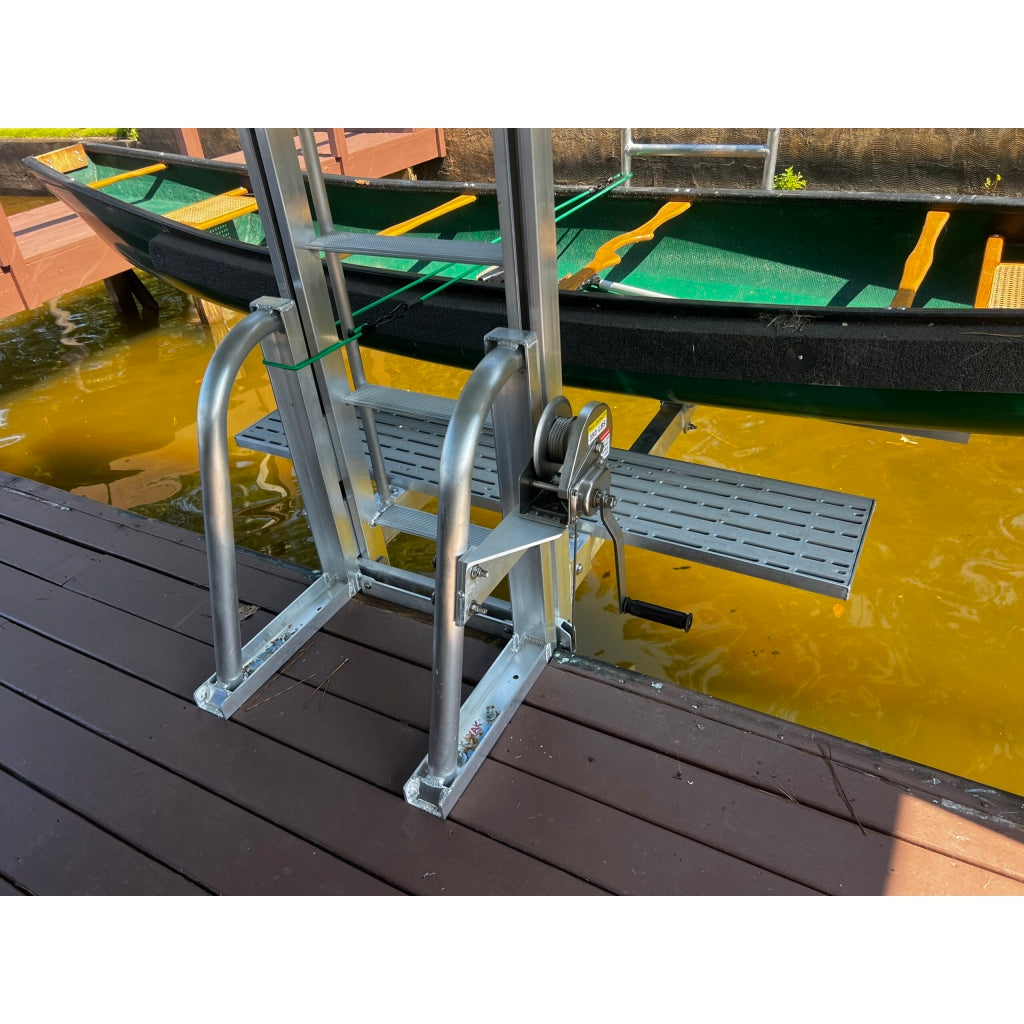
A launch like the Kayak Launch mounts to the dock edge or seawall face. From the dock, you crank a hand winch to lower the empty kayak in its cradle until it sits at the waterline between adjustable bunks. Then you go down a short set of steps holding a fixed grab rail and sit into a kayak that the bunks hold steady instead of letting it drift. Coming back, you paddle into the cradle, use the steps and rail to climb out, and crank the empty kayak back up from the dock.
What that changes for a paddler with bad knees or less balance than they used to have: the kayak stays put, there is something solid to hold at every step, and you never step from a high dock straight down into a moving boat. One customer wrote in a review on our product page that their 5 Step Standard "provides excellent stability for everyone, from my kids to my parents."
Two limits to be straight about. The launch fits docks up to about 32 inches above the water at low tide: the 3 Step up to about 16 inches, the 5 Step from 16 to 24 inches, and the 7 Step from 24 to 32 inches. Above that, none of the models reach. And the owner's manual is clear that the winch is operated from the dock or seawall, never from inside the kayak, so the kayak is lowered first and you get in after.
Safety basics for any dock entry
- Life jacket on before you step in.
- One person on a ladder or launch steps at a time.
- Check the water depth beside the dock at low tide before relying on it.
- Watch for boat wakes before you commit your weight. Wait for one to pass.
- Never stand or reach under a raised launch cradle.
- If a helper is on the dock, their job is to hold the kayak, not to lift you.
Which approach fits your dock?
| Your situation | Best fit |
|---|---|
| Floating dock near the water | Sit-and-slide technique, or a floating launch platform |
| Fixed dock or seawall up to 32 in above low water | Kayak Launch, sized by dock height |
| Fixed dock or seawall more than 32 in above low water | Ladder with rails for confident paddlers. A Kayak Launch will not reach. |
| Boarding a boat rather than a kayak | See getting everyone aboard safely |
If a launch sounds like the answer, measure the drop from your dock to the water at low tide and the widest point of your kayak. Those two numbers pick the model, and our kayak launch buyer's guide walks through the rest. You can also browse the kayak launch collection.
Frequently asked questions
What is the easiest way to get into a kayak from a dock?
From a low or floating dock, sit on the dock edge with your feet in the cockpit, keep one hand on the dock, and lower your seat straight down into the kayak in one move. From a higher fixed dock or seawall, the easiest way is a launch that holds the kayak at the waterline with steps and a grab rail, so you are not stepping down into a moving boat.
How do seniors get in and out of a kayak at a dock?
The safest setups remove the long step and the moving boat: a floating dock close to the water, a ladder with hand rails, or a dock-mounted launch that holds the kayak still while you use the steps and rail. Getting out is usually the harder half, so plan the exit before the paddle, and have any helper hold the kayak rather than pull on your arms.
How do you get out of a kayak onto a high dock?
Without equipment it is difficult and often unsafe, because you have to lift your whole body from a seat at the waterline. Use a ladder with rails, pull the kayak tight to it, and climb rather than stand. On a fixed dock up to 32 inches above low water, a kayak launch with steps and a grab rail lets you climb out at the waterline and then crank the empty kayak up from the dock.
Why is my dock harder to get into a kayak from in the afternoon?
Probably the tide. On a fixed dock or seawall the drop to the water grows as the tide goes out. NOAA tide stations around Florida show typical daily ranges from about 16 inches at Fort Myers to about 34 inches at Naples and about 59 inches at Mayport, so the same dock can feel completely different a few hours later.
Can you stay in the kayak while the launch lowers it?
No. The Kayak Launch owner's manual says the winch is operated from the dock or seawall and never from inside the vessel. Lower the kayak to the waterline first, then use the steps and grab rail to get in.


Leave a comment
This site is protected by hCaptcha and the hCaptcha Privacy Policy and Terms of Service apply.