
Kayak launch maintenance comes down to three habits: rinse the salt off with fresh water after you use it in salt water, keep oil and grease away from the winch brake, and look over the cable and bolts once a month. Do those three things and an aluminum launch with stainless hardware needs very little else, but skip the rinse on a Florida canal and salt goes to work on every crevice the frame has.
This guide is written around the Kayak Launch we sell (welded aluminum frame, stainless steel brake winch and cable, adjustable aluminum bunks), but the routine applies to most dock-mounted launches. It also corrects one piece of advice that circulates widely, including on an older version of this page: "lubricate the winch regularly." On a brake winch, grease in the wrong place is how you lose the brake.
What does a kayak launch need, and how often?
| When | What to do | Why it matters |
|---|---|---|
| After each use in salt or brackish water | Low-pressure freshwater rinse of the frame, cradle, bunks, cable and winch. Raise the cradle out of the water. | Salt left to dry concentrates in welds, bunk slots and under bolt heads. |
| Weekly in fresh water | Rinse off pollen, algae film and bird droppings. | Keeps the steps and hand rail from getting slick. |
| Monthly | Inspect the cable end to end, test the winch brake, check that mounting bolts and bunk bolts are snug. | Cable damage and loose bolts give warning before they fail, if you look. |
| Twice a year | Wash with mild soap, lubricate only the winch points its manual names, check the hand rail and steps for movement. | Catches slow problems: wear on the gear teeth, a rail that has started to rock. |
| Before a named storm | Take the kayak off, raise and secure the cradle, photograph the launch. | A loose kayak or a swinging cradle is the most likely storm damage. |
| After a storm | Inspect before loading: mounts, cable, brake, frame. | The dock may have moved even if the launch looks fine. |
Why salt water is the real maintenance problem, even for stainless steel
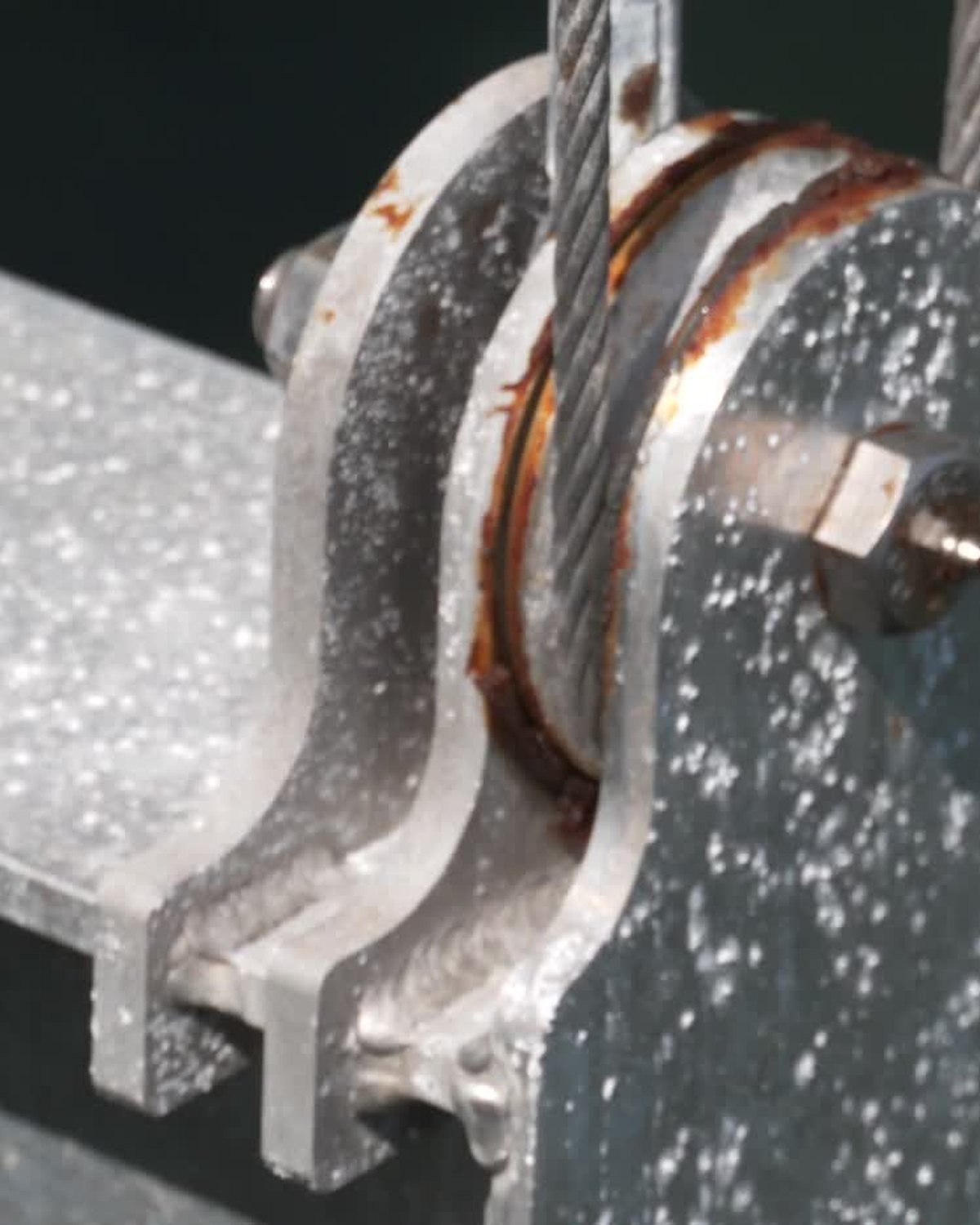
"Stainless" means stain-less, not stain-proof. Stainless steel protects itself with a thin chromium oxide film, and chloride is what breaks that film down. The Australian Stainless Steel Development Association gives rough guideline limits for immersed service in neutral water at ambient temperature: about 200 ppm chloride for grade 304 and about 1,000 ppm for grade 316. Seawater sits far above both. That is why stainless hardware on a saltwater dock relies on being kept clean. Once dried salt crust sits on the surface, you see the brown "tea staining" that eventually turns into pitting.
The aluminum frame works the same way. Aluminum forms its own oxide skin and handles salt air well, but salt and grime packed into a crevice hold moisture against the metal long after the rest of the frame has dried. On the Kayak Launch those crevices are predictable: weld joints, the slots and fasteners on the adjustable bunks, the winch mount, and anywhere a stainless bolt passes through aluminum.
That last point matters for repairs. Stainless fasteners in an aluminum frame are a designed pairing. A zinc-plated or galvanized bolt from the hardware store is not. If a fastener ever needs replacing, replace it with stainless of the same size, never with whatever is in the garage.
How do you clean an aluminum kayak launch?
- Rinse with fresh water at garden-hose pressure. A pressure washer drives water and salt into the winch housing and under bolt heads, which is the opposite of what you want.
- Wash with a mild soap and a soft brush once or twice a season, or whenever the frame feels gritty. Work top to bottom and rinse well so no soap film is left to collect dirt.
- Pay attention to the hidden spots: the underside of the cradle, the cable where it wraps the winch drum, and the bunk slots.
- Let it dry raised. Water that sits in a lowered cradle keeps the bottom of the frame wet.
What not to use: strong alkaline products such as oven cleaner or anything caustic, which attack aluminum, and steel wool or steel brushes, which leave iron particles that rust on the surface and look like corrosion on the launch itself. Fresh water and mild soap cover almost everything a launch needs.
Should you grease the winch? Not the brake
This is the piece of kayak launch maintenance most likely to be done wrong. The Kayak Launch uses a hand-crank brake winch. A brake winch holds the load by friction: when you stop cranking, friction surfaces inside the winch lock the drum so the kayak stays where you left it.
Winch makers are blunt about this. Dutton-Lainson's brake winch manual says "Do not grease or oil any of the brake mechanism parts." Fulton's instructions say "Do not get oil or grease on the friction disks." Both tell you to put a light film of grease on the gear teeth and oil on specific bushings and threads. Spray a general-purpose lubricant into the whole winch "to keep it smooth" and you can contaminate the brake, which is how a cradle starts to creep down on its own.
So the rule is: lubricate only the points the winch's own instructions name, sparingly, and keep everything off the brake. If you are unsure which parts are which, rinse the winch and leave the lubrication alone until you have checked.
The monthly brake test
With the kayak in the cradle and the cradle partway up, stand on the dock, take your hand off the crank, and watch for a minute. The cradle should not move. If it creeps, stop using the launch, keep the kayak off it, and contact us before going further. A brake that slips is not something to work around. If the winch itself needs replacing, the stainless steel kayak winch is sold separately.
How do you inspect the cable?
Wear gloves. A broken wire strand will cut a bare hand that runs along the cable. Then, with the cradle lowered so the full length of cable is exposed, look for:
- Broken wires sticking out of the strand, especially near the end fittings and where the cable wraps the drum.
- Kinks or flattened sections from the cable being pinched or wound unevenly.
- Bird-caging, where the strands open up into a basket shape.
- Rust staining or pitting at the fittings, where salt collects first.
- Uneven winding on the drum. The cable should lay on neatly as you crank up, not pile up on one side.
Any one of the first four means the cable is due for replacement before the next use. Do not try to splice or clamp a damaged section.
Bunks, hand rail, steps and mounting bolts
The parts you hold and stand on deserve the same attention as the parts that carry the kayak.
- Hand rail and steps: grab the rail and push it in every direction. It should not rock. This is what you lean on while getting into the kayak, so a loose rail is a safety problem, not a cosmetic one.
- Bunks: check that the adjustment bolts are snug and both bunks sit at the width you set for your hull. If you change kayaks, reset them.
- Mounting bolts: on a wooden dock, check these more often in the first few months, while the wood settles around the fasteners. Snug them, but do not crush the wood or overtighten into aluminum.
- The dock itself: the launch is only as solid as what it is bolted to. Soft decking, a cracked seawall cap or a wobbling piling is work for a dock contractor, and worth doing before it shows up as a loose launch.
Why you should store the launch raised
The Kayak Launch owner's manual recommends raising the launch to its upward position when it is not in use. There is a maintenance reason as well as a safety one: a cradle left sitting in the water collects marine growth, and the submerged cable spends its life wet. Raised, the cradle drains, the cable dries, and the barnacles have nothing to settle on. The manual also says never to go under the lift or the vessel, especially when it is raised.
How do you prepare a kayak launch for a hurricane?
Atlantic hurricane season runs June 1 to November 30. When a named storm is forecast for your area:
- Take the kayak off the launch and store it inside. A kayak left in the cradle is a large, light object in high wind.
- Raise the cradle fully and secure it with a strap so it cannot swing.
- Remove anything loose from the launch and the dock around it: paddles, seat pads, bungees.
- Photograph the launch and its mounts. Manufacturer warranties typically exclude storm damage (see our returns and warranty policy), so dated photos are what you will want for a homeowner's insurance conversation.
After the storm, do not load the launch until you have checked it. Look at the mounting bolts and the dock or seawall they go into, run the cable inspection above, test the brake with the cradle empty and then with the kayak, and look along the frame for anything bent. A storm surge can shift a dock or seawall cap without obvious damage on top.
Lakes, rivers and freezing winters
Freshwater launches need less rinsing but more scrubbing: algae film on steps and rails is the main problem, and a soft brush with mild soap handles it. Where lake levels move with the seasons or with dam releases, re-check your dock height at the low point of the year, because that is the number that decides whether the cradle still reaches the water.
Where the water freezes, raise the cradle out of the water before ice forms and keep the kayak off it for the winter. Ice moving against a submerged cradle is a load the launch is not built to take. In spring, run the full monthly check before the first paddle.
What maintenance cannot fix
Rinsing and inspection protect the launch. They do not protect against a launch that never fit the dock. If your cradle cannot reach the water at low tide, no routine changes that. Dock height decides the model (up to about 16 inches for the 3 Step, 16 to 24 inches for the 5 Step, 24 to 32 inches for the 7 Step), and our kayak launch buyer's guide explains how to measure at low tide. If you are on Tampa Bay, our Tampa Bay kayak launch page covers the local tidal range.
If you are still choosing a launch, it is worth knowing before you buy that the routine above is the whole job: a hose, a soft brush, a monthly look at the cable and a brake test. You can see the configurations and what is included on the Kayak Launch product page.
Frequently asked questions
How often should you rinse a kayak launch in salt water?
Rinse it with fresh water after every use in salt or brackish water, and raise the cradle out of the water to dry. Salt that dries on the frame concentrates in welds, bunk slots and under bolt heads, which is where corrosion starts on both aluminum and stainless steel.
Should I grease the winch on my kayak launch?
Only the points the winch's instructions name, such as the gear teeth, and never the brake. A brake winch holds the load by friction, and brake winch makers including Dutton-Lainson and Fulton tell owners not to put oil or grease on the brake parts. Grease on the brake can let the cradle creep down under load.
Does stainless steel rust on a saltwater dock?
It can stain and pit if salt is left on it. Stainless steel relies on a thin oxide film that chloride breaks down, and seawater carries far more chloride than the levels stainless grades are rated to resist when immersed. A regular freshwater rinse is what keeps stainless hardware looking and performing like stainless.
When should I replace the cable on a kayak launch?
Replace it before the next use if you find broken wires, kinks or flattened sections, bird-caging, or rust and pitting at the end fittings. Inspect it monthly with gloves on and the cradle lowered so the whole length is visible.
What should I do with my kayak launch before a hurricane?
Take the kayak off and store it inside, raise the cradle fully and strap it so it cannot swing, remove loose items from the dock, and photograph the launch and mounts. After the storm, inspect the mounts, cable, brake and frame before loading it again.
Should I leave my kayak launch up or down when I am not using it?
Up. The owner's manual recommends raising the launch to its upward position when not in use, and a raised cradle drains and dries instead of collecting marine growth.


Leave a comment
This site is protected by hCaptcha and the hCaptcha Privacy Policy and Terms of Service apply.