There is no honest single answer to how long a boat lift lasts, because a lift is not one thing. It is an aluminum or steel frame, a set of cables, sheaves, a motor and gearbox, electrical controls, bunks and sacrificial anodes, and each of those wears out on its own clock. The frame can outlast its owner while the cables, anodes and electrical parts need attention every few years, sooner in salt water. We looked for a credible published average lifespan for a whole boat lift and could not find one from any manufacturer, standards body or independent study. Anyone quoting one number, including the old version of this page (which claimed 50 to 100 years), is guessing.
What the evidence does support is a part-by-part picture: which parts wear first, how much faster salt water and Florida heat push them, and what a saltwater owner can check each month and each year to stretch every part's life. That is what this guide covers.
What actually wears out on a boat lift, and in what order?
The parts that move, bend around sheaves, carry electricity or sit underwater wear out first. The frame changes slowly. Here is how each part fails and what the best available sources say about it.
| Part | What wears it out | What the evidence says | Check it |
|---|---|---|---|
| Aluminum frame | Galvanic corrosion where it touches other metals, pitting in stagnant salt water | Resists corrosion well, but is not immune. We found no public long-term field data on lift frames. | Yearly, at every bolt and bracket |
| Galvanized steel parts | Zinc coating consumed, faster underwater than in air | Decades in coastal air, a few years fully submerged in warm seawater (American Galvanizers Association) | Yearly, especially below the waterline |
| Stainless hardware | Pitting and crevice corrosion, mostly in grade 304 | 304 is not suitable for seawater; 316 is the minimum near the coast, and even 316 can pit in crevices | Yearly, look for rust staining |
| Cables | Bending fatigue over sheaves, corrosion, kinks | No universal replacement interval; replace on condition | Every season, plus after storms |
| Sheaves and pulleys | Bearing and groove wear, lack of grease | Worn grooves damage cables | Yearly |
| Motor and gearbox | Water entry, condensation, heat, salt | No credible lifespan data exists for lift motors | Monthly look, yearly service |
| Electrical and GFCI | Moisture, salt, lightning surges | Test GFCIs monthly and after storms (ESFI) | Monthly |
| Anodes (zincs) | Designed to be consumed | Replace yearly or when more than half wasted (BoatUS) | Every few months in salt |
How long does the frame last?
Aluminum frames
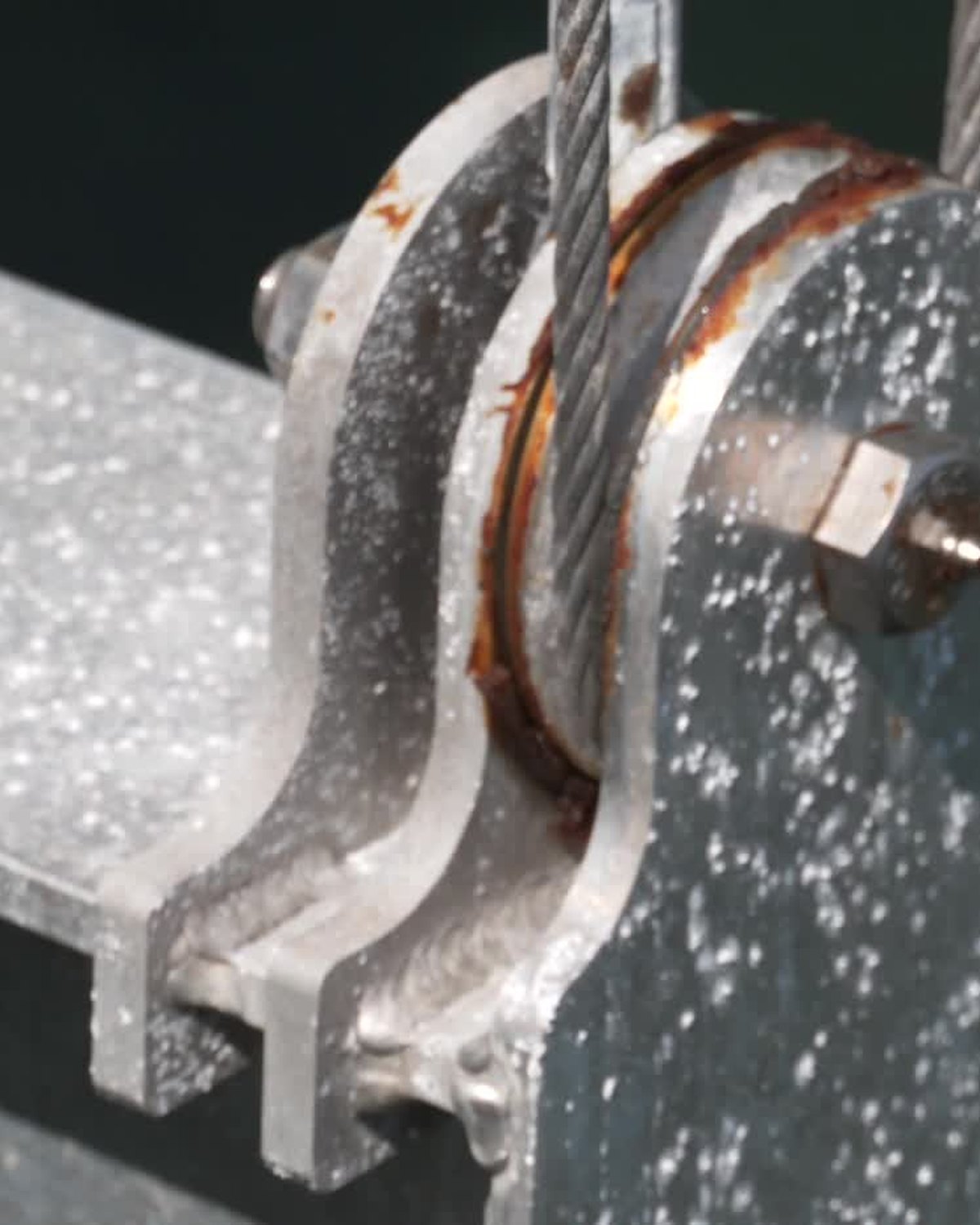
Aluminum forms its own protective oxide layer, which is why it dominates saltwater lift construction. But "aluminum doesn't rust" is not the same as "aluminum lasts forever." Its main enemy on a lift is galvanic corrosion: in salt water, aluminum electrically connected to a more noble metal (stainless steel, copper, bronze) becomes the part that corrodes. That is why the places to watch on an aluminum lift are the joints, where stainless bolts pass through aluminum brackets, and anywhere a copper wire, brass fitting or steel part touches the frame.
The general design rule is that a small stainless fastener in a large aluminum part is the less damaging combination, while a small aluminum part attached to a large stainless part is the bad one. Barrier compounds or insulating washers and sleeves at the joint reduce the contact. Pitting, white powdery buildup, or a crusty ring around a bolt head are the early signs.
We could not find published long-term exposure data for boat lift frames specifically, so we are not going to give you a number of years. A well-built aluminum frame that is kept free of dissimilar-metal contact will normally be the last major part you replace.
Galvanized steel frames and parts
Galvanized steel is protected by a zinc coating that sacrifices itself over time. The American Galvanizers Association (AGA) publishes how long that takes, and the numbers show something most owners never hear: the same coating lasts dramatically longer in air than underwater.
- In air, AGA's chart estimates roughly 46 years to first maintenance in a tropical marine environment for a 3.9 mil hot-dip coating (the standard minimum for structural steel at least a quarter inch thick), and about 70 years in a temperate marine environment. "First maintenance" means about 5 percent of the surface showing rust.
- Fully immersed, AGA gives typical zinc loss of about 1 mil per year in tropical seawater and about 0.5 mil per year in temperate seawater, with time to first maintenance of "5+ years" depending on the water.
So on a galvanized lift in Florida, the parts that live in the water or the splash zone are the ones on a short clock, while the same steel a few feet up can last decades. Thinner coatings (on small hardware and on the individual wires in galvanized cable) are consumed faster than the structural figures above.
Why do parts under the canopy corrode faster?
This is the counterintuitive one. In salty coastal air, metal that is sheltered from rain often corrodes faster than metal out in the open, because rain is what rinses salt off. New Zealand's building research agency (BRANZ) measured corrosion rates in sheltered locations in a severe marine environment at about 2.5 times the open-air rate, and a Sandia National Laboratories report found sheltering can more than double zinc corrosion rates in coastal environments.
On a boat lift, the sheltered places are the motor and gearbox, the underside of the top beams, and everything under a canopy. They collect salt spray and never get washed. The fix costs nothing: rinse them with fresh water from a hose regularly, especially after windy days and storms. A motor cover keeps direct sun, rain and canopy runoff off a C-Face motor, but it also shelters it, so lift the cover and wipe the salt off a few times a season.
How often should boat lift cables be replaced?
On condition, not on a calendar. We could not find any lift manufacturer that publishes a fixed replacement interval. ShoreStation's owner's guide says to inspect the lift at the start of each season, check cables for "fraying, wearing and deterioration" and the attachment ends, and "If any of the above signs appear, replace the cables immediately."
Wire rope industry guidance (summarizing the ASME B30 rope standard) lists these reasons to take a rope out of service:
- Broken or protruding wires
- Any kink, birdcaging (strands opening up like a cage), or crushing that flattens the rope
- Diameter worn more than 5 percent below nominal
- Widespread corrosion or pitting
- Corroded, cracked or damaged end fittings, which is where saltwater cables most often show trouble first
Run a rag along the cable with the lift empty: broken wires snag it. Look hardest at the sections that wrap the winder and pass over sheaves at the lift's usual resting position, because those spots flex every cycle and sit wet.
Stainless or galvanized cable in salt water?
Stainless resists salt corrosion far better than galvanized, which is why many saltwater owners choose it. But cable is a load-rated part. The right choice is the diameter, construction and rating your lift maker specifies, not a material swap on its own. We sell stainless steel lift cable by the foot in diameters from 3/16" to 1/2", and the rest of our cables and rigging range, but match the size to your lift's spec plate or manual before ordering.
Which stainless steel is right for saltwater hardware?
Grade matters more than the word "stainless." The British Stainless Steel Association says plainly that 304 types "should not be considered suitable for seawater service." The Australian Stainless Steel Development Association recommends grade 316 "as a minimum within five kilometres of the surf," and warns that 304 can tea-stain (brown surface rust) or corrode more seriously near the coast.
Even 316 is not seawater-proof. Both associations warn about crevice corrosion in tight gaps, under washers and in stagnant water, which is exactly where lift hardware lives. Rust staining on stainless bolts is a sign worth acting on, not a cosmetic issue.
How often should you replace the zincs on a boat lift?
BoatUS's rule for anodes is to replace them "yearly or any time they're more than half wasted," and to check them more often in salt water than in fresh. Three points matter for lift owners:
- Match the anode to the water. BoatUS says magnesium anodes work better in fresh water, and that boats moving to salt water should switch to aluminum anodes where available, or zinc. Zinc has the opposite problem in fresh water: it can coat over and stop protecting.
- An anode only protects metal it is electrically connected to. A zinc on your boat does nothing for your lift.
- Anodes vanishing in a few months is a warning, not a maintenance item. Unusually fast consumption can point to stray electrical current in the water, often from a wiring fault on a dock or a nearby boat. Have it traced by an electrician; a bigger zinc does not fix a live fault.
Our weights and zincs collection includes a 3.5 lb zinc with a 15-foot stainless cable made for elevator boat lifts. Other lift types use different anode mounts, so check what your lift has before ordering.
How long does a boat lift motor last?
We could not find any credible study of boat lift motor lifespan. The figures you will see online ("7 to 12 years," "half that in salt water") come from blogs and affiliate sites without data behind them, so we are not repeating them as fact.
What is documented is why lift motors fail. Industry surveys of electric motors (large industrial motors, not lift motors) find bearings are the most common failure point, and ABB, which owns the Baldor motor brand, names moisture as a leading cause of bearing failure and internal rust. "Totally enclosed" motors are not airtight, and some purpose-built boat hoist motors carry only an IP43 rating with drain holes at the bottom, meaning they are rated for falling spray, not for splashing from every direction. Heat matters too: Baldor (ABB) gives the rule of thumb that every 10°C rise in winding temperature cuts insulation life in half, and South Florida is the place industry uses as its benchmark for harsh sun exposure.
In practice: keep canopy runoff off the motor, keep salt rinsed off it, keep drain holes clear, and listen for changes (grinding, humming without turning, or a lift that slows under its normal load). If a motor or drive does need replacing, our boat lift motors include C-Face and footed styles. They are not interchangeable, so confirm which mount your drive uses first.
What do warranties tell you about lifespan?
A warranty is not a lifespan, but the fine print shows where makers expect trouble. Examples from published documents:
- Sunstream warrants its lifts for three years "in both fresh and salt water," but excludes salt water damage from "electrolysis, corrosion or environmental causes" and makes zinc anode maintenance the owner's job.
- HydroHoist's 2020 limited warranty gives 10 years on tanks and 3 years on other lift components, and excludes fire, flood, wind and lightning damage.
- ShoreStation advertises a 15-year cable warranty and, in its aluminum lift warranty, excludes electrical damage caused by corrosion or submersion and lists salt and ocean spray among "environmental factors."
The pattern is consistent: corrosion, salt, electrolysis and storms are usually the owner's risk. Maintenance is what protects you, not the warranty. Check the current warranty document for your own lift, since terms change by model and year.
A saltwater boat lift maintenance schedule
| How often | What to do |
|---|---|
| Monthly | Press the GFCI test and reset buttons. Rinse the motor, gearbox, top beams and anything under the canopy with fresh water. Walk the cables for snags, kinks or rust at the ends. |
| Every few months | Check anodes. Grease sheaves that have grease fittings. Lift the motor cover and wipe off salt. |
| Every season (or yearly) | Full cable inspection against the removal criteria above. Replace anodes that are half gone. Check every bolt where stainless meets aluminum. Inspect sheaves for wobble and groove wear. Look over bunks and carpet. Run the lift through a full cycle and listen to the motor. |
| After every storm | Test the GFCI (ESFI recommends testing after every major electrical storm), rinse, inspect cables and structure. If anything electrical was submerged, see our boat lift hurricane preparation guide before switching it back on. |
If you are not sure which parts your lift uses, start from shop by lift type or our fit help page.
When should you call a professional?
- Cracked welds, bent beams or pilings that move. These are structural and need a lift installer or marine contractor.
- Anodes disappearing fast, tingling in the water, or tripping GFCIs. Call a licensed electrician. Dock wiring falls under its own article of the National Electrical Code, and stray current is a safety issue, not just a corrosion one.
- Re-cabling a large lift. Plenty of owners replace their own cables, but if you are unsure about routing, terminations or the right rating, a lift service company will do it right the first time.
Good contractors would rather catch a corroded bracket on a routine visit than rebuild a lift after it lets go. A yearly look from a pro, paired with your own monthly rinse and checks, is how lifts reach old age.
Frequently Asked Questions
How long does a boat lift last?
There is no credible published average for a whole boat lift. The frame is usually the longest-lived part, while cables, anodes, electrical parts and motors wear out on shorter and different schedules, faster in salt water. Inspecting and replacing those wear parts on condition is what determines how long the lift as a whole stays in service.
How often should boat lift cables be replaced?
Replace cables based on condition, not a fixed calendar. Inspect them every season and after storms, and replace them if you find broken wires, kinks, birdcaging, crushing, heavy corrosion, diameter loss of more than 5 percent, or damaged end fittings.
Is stainless or galvanized cable better for salt water?
Stainless resists salt corrosion better than galvanized, which is why many saltwater owners choose it. Cable is a load-rated part, though, so use the diameter, construction and rating your lift maker specifies rather than swapping on material alone.
How often should I replace the zinc on my boat lift?
BoatUS recommends replacing anodes yearly or whenever they are more than half wasted, and checking them more often in salt water. If anodes disappear within a few months, have an electrician check for stray current.
Does a boat lift last longer in fresh water than salt water?
The parts most affected by water do. Galvanized coatings, stainless hardware and anodes all degrade faster in warm seawater than in fresh water, according to the American Galvanizers Association and stainless steel industry bodies. No study gives a whole-lift lifespan for either environment.
What maintenance makes the biggest difference in salt water?
Rinsing the lift with fresh water, especially the motor and the parts sheltered from rain, plus regular anode replacement and a cable inspection every season. Sheltered metal near the coast can corrode more than twice as fast as exposed metal because rain never washes the salt off.
Sources
- American Galvanizers Association, Performance of Galvanized Steel in Different Environments: https://galvanizeit.org/knowledgebase/article/performance-of-galvanized-steel-in-different-environments
- American Galvanizers Association, Hot-Dip Galvanized Steel Performance in Water Environments: https://galvanizeit.org/hot-dip-galvanizing/how-long-does-hdg-last/in-water
- British Stainless Steel Association, Selection of 316, 304 and 303 Stainless Steels for Seawater Applications: https://bssa.org.uk/bssa_articles/selection-of-316-304-and-303-types-of-stainless-steels-for-seawater-applications/
- ASSDA, Preventing Coastal Corrosion (Tea Staining): https://www.assda.asn.au/publications/technical-faqs/preventing-coastal-corrosion-tea-staining
- BRANZ, Positional Material Deterioration over the Building Envelope (SR457): https://www.branz.co.nz/assets/publications/SR457_Positional_material_deterioration_over_the_building_envelope_Gxhs6d3.pdf
- Sandia National Laboratories via OSTI (1996), sheltered zinc corrosion: https://www.osti.gov/servlets/purl/810007
- BoatUS, Moving a Boat from Freshwater to Saltwater (anodes): https://www.boatus.com/expert-advice/expert-advice-archive/2017/october/moving-a-boat-from-freshwater-to-saltwater
- BoatUS, Install a Galvanic Isolator (anode types by water): https://boatus.com/expert-advice/expert-advice-archive/2026/august/install-a-galvanic-isolator
- ShoreStation, Owner's Guide, Vertical Lift Boat Lifts: https://cdn.datamanager.arinet.com/file/MWI/%7B15EF5833-DC36-41B3-820C-361AAA084013%7D
- ShoreStation, Warranty Info: https://www.shorestation.com/service/warranty-info
- ShoreStation, Aluminum Boat Lift Warranty: https://shorestation.com/PDF_docs/ShoreStation-Aluminum-Boat-Lift-Warranty.pdf
- Sunstream, Warranty: https://sunstreamboatlifts.com/warranty/
- HydroHoist, Limited Warranty (2020, dealer-hosted copy): https://approvedmarine.com/wp-content/uploads/sites/31/2020/01/HydroHoist-Boat-Lift-Warranty-01.07.20.pdf
- Union Rope, When to Replace Your Ropes: https://www.unionrope.com/Portals/0/Documents/Technical/Crane/when-to-replace.pdf
- ESFI, Electrical Safety Check (GFCI testing): https://www.esfi.org/wp-content/uploads/2021/08/Indoor-Electrical-Safety-Check-Booklet-3FB3.pdf
- boats.com, Protecting Against Marine Corrosion (zinc passivation in fresh water): https://www.boats.com/reviews/protecting-against-marine-corrosion/
- ABB/Baldor grain handling motor brochure BR265 (moisture and bearing failure; manufacturer brochure, moderate): https://www.baldor.com/mvc/DownloadCenter/Files/BR265
- Idaho National Laboratory, Online Monitoring of Induction Motors (motor failure surveys): https://lwrs.inl.gov/content/uploads/11/2024/03/Online_Monitoring_of_Induction_Motors.pdf
- Baldor (ABB), TEFC enclosure definition: https://config.baldor.com/Help/LAC/LAC_Enclosure_Help.pdf
- Leeson boat hoist motor specification (IP43, drain holes), distributor listing: https://www.electricmotorwholesale.com/LEESON-117497
- Baldor (ABB), winding temperature and insulation life: https://www.baldor.com/our-profile/news/company-news/detail?id=%7B90476AB1-4A10-4ED0-9DFD-7B3E83F801DA%7D
- Atlas Material Testing, Florida benchmark outdoor exposure sites: https://www.atlas-mts.com/products/weathering-test-services/natural-weathering/natural-weathering-testing-sites/north-american-sites/florida-benchmark-testing-sites


Leave a comment
This site is protected by hCaptcha and the hCaptcha Privacy Policy and Terms of Service apply.