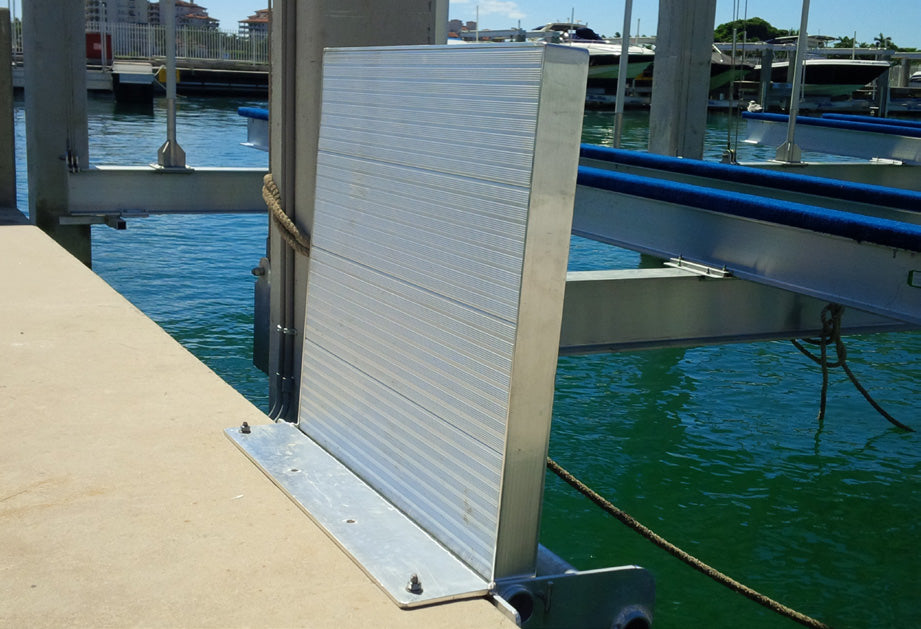
Hinged Boarding Platform
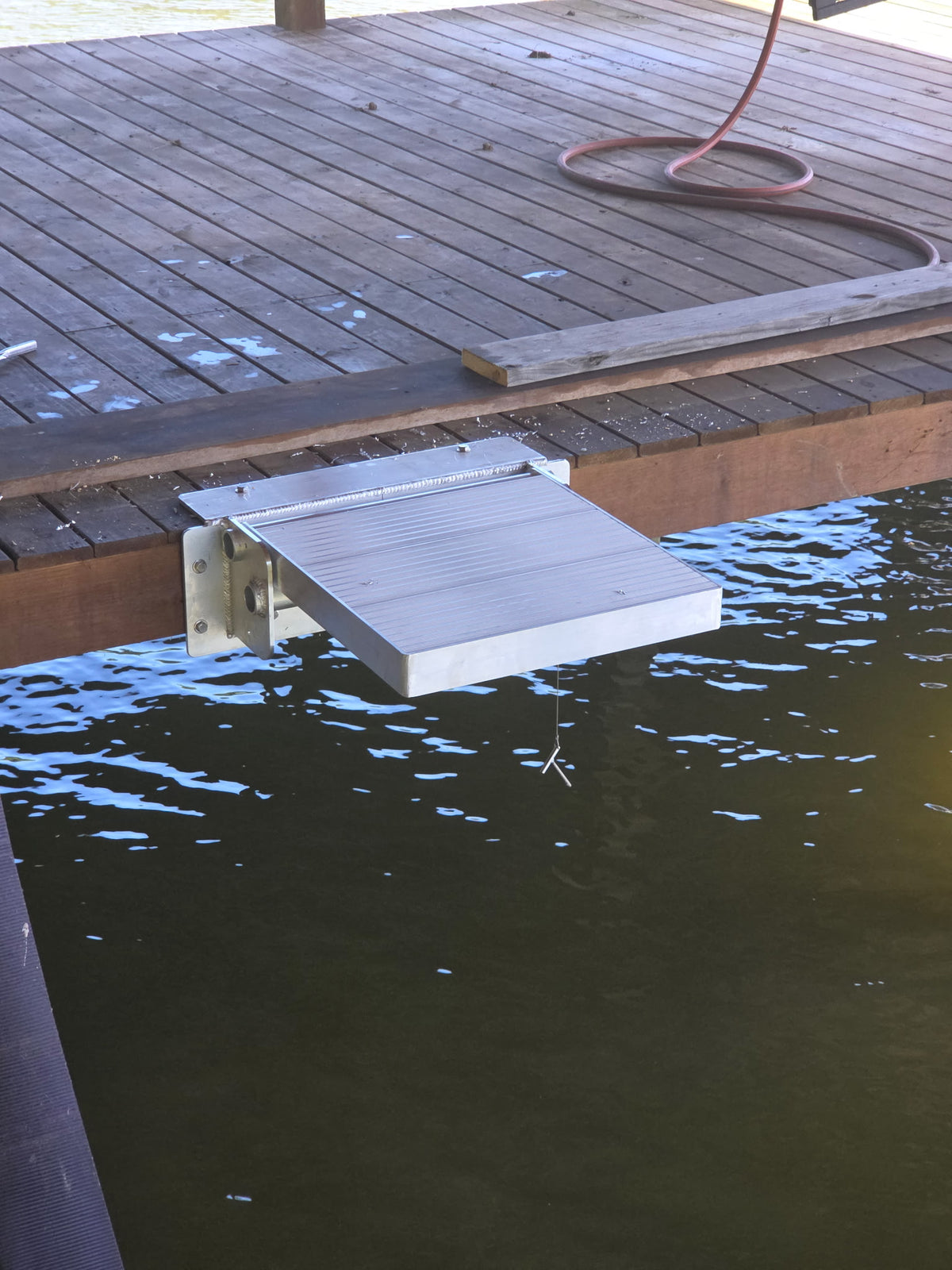
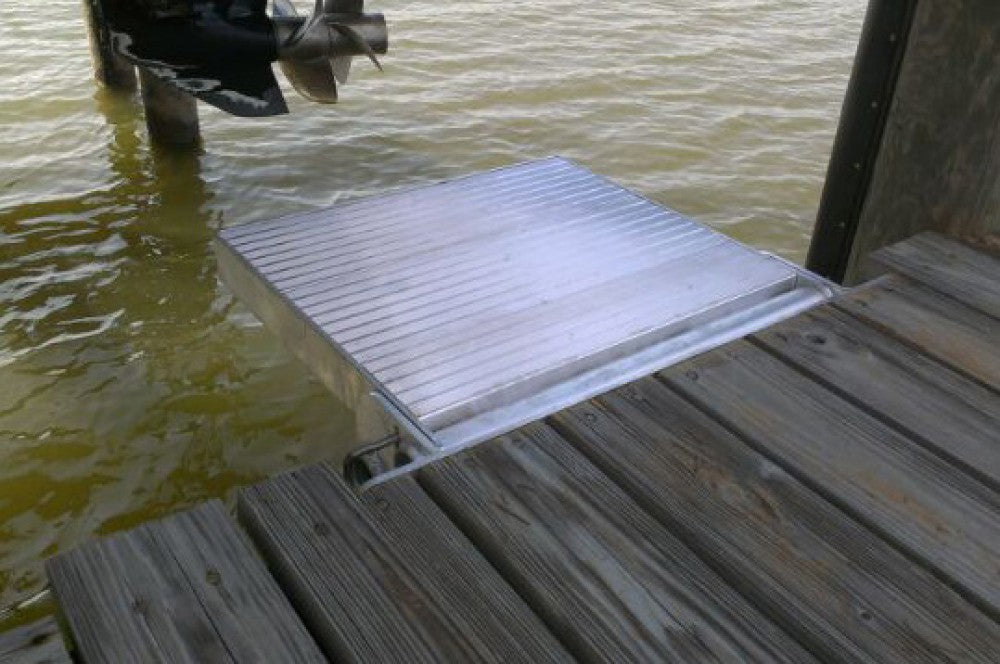
A hinged aluminum platform that closes the gap between your dock and your boat, then swings up out of the way when you are done. Bolts to a wood dock, a concrete dock or a seawall.
- 24 or 36 inches wide; the 3 ft gives more room underfoot for carrying gear
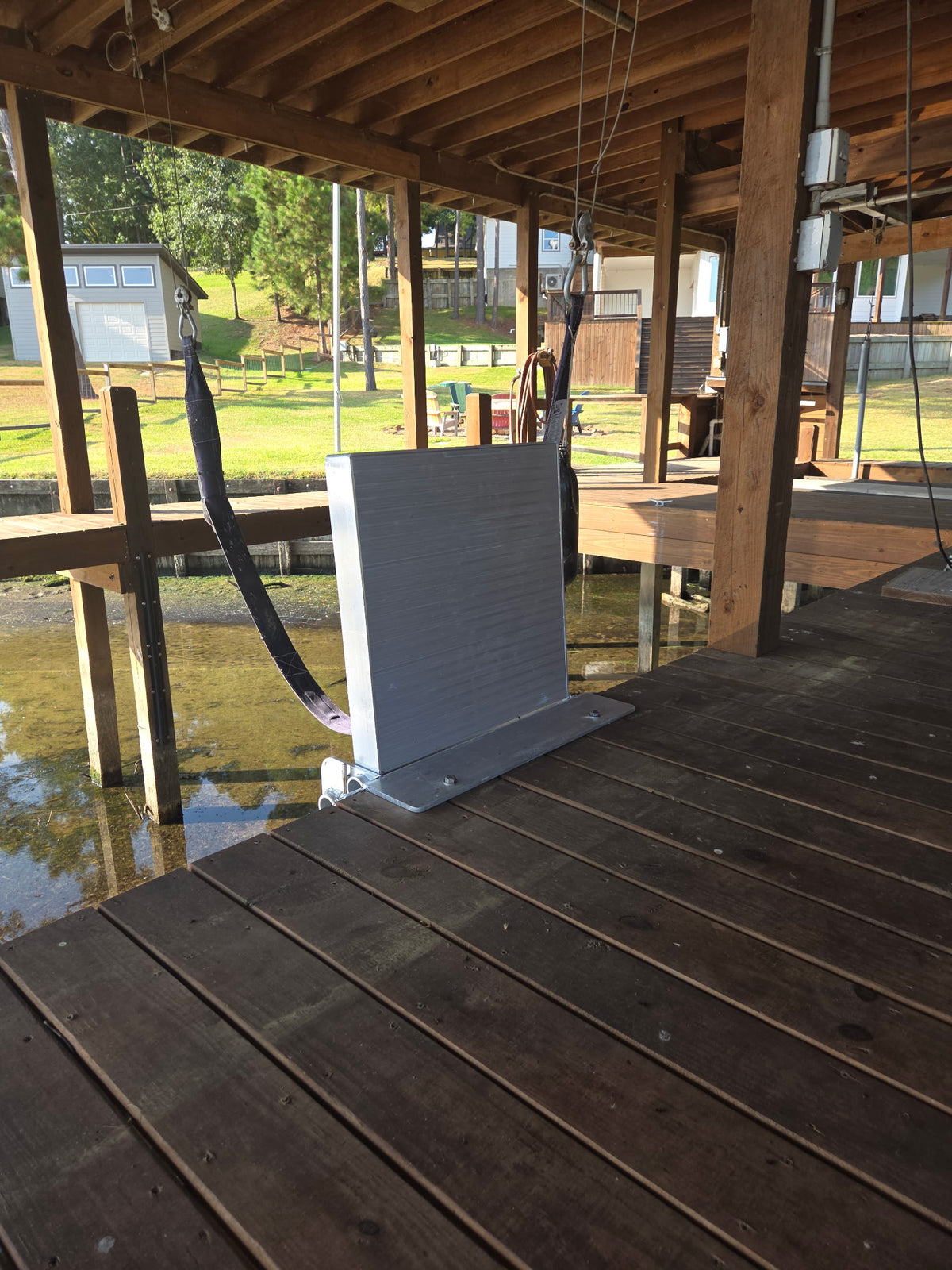
- Swings up against the dock when you are not boarding, so the deck and the water stay clear
- Welded 6061-T6 aluminum with a Schedule 80 pivot tube
- Engineered to 180 MPH and sealed by a Florida licensed P.E.
Sales tax is calculated at checkout.
Shipped from the manufacturer to your dock. If anything arrives damaged or wrong, we make it right.
How that works
There is no sending a welded aluminum platform back and forth by freight, so check the size and mount sections on this page before you order.
If it arrives damaged or there is a workmanship problem, note it on the delivery receipt, photograph it, and email us the same day. We open the claim with the manufacturer and stay on it until it is resolved. You are not left negotiating with a freight carrier on your own.
Ships from the manufacturer by December 16
Freight transit time is additional and set by the carrier. We send tracking the day it ships.
Questions before you order? Contact us.
See it work
Down when you need it. Up when you don’t.
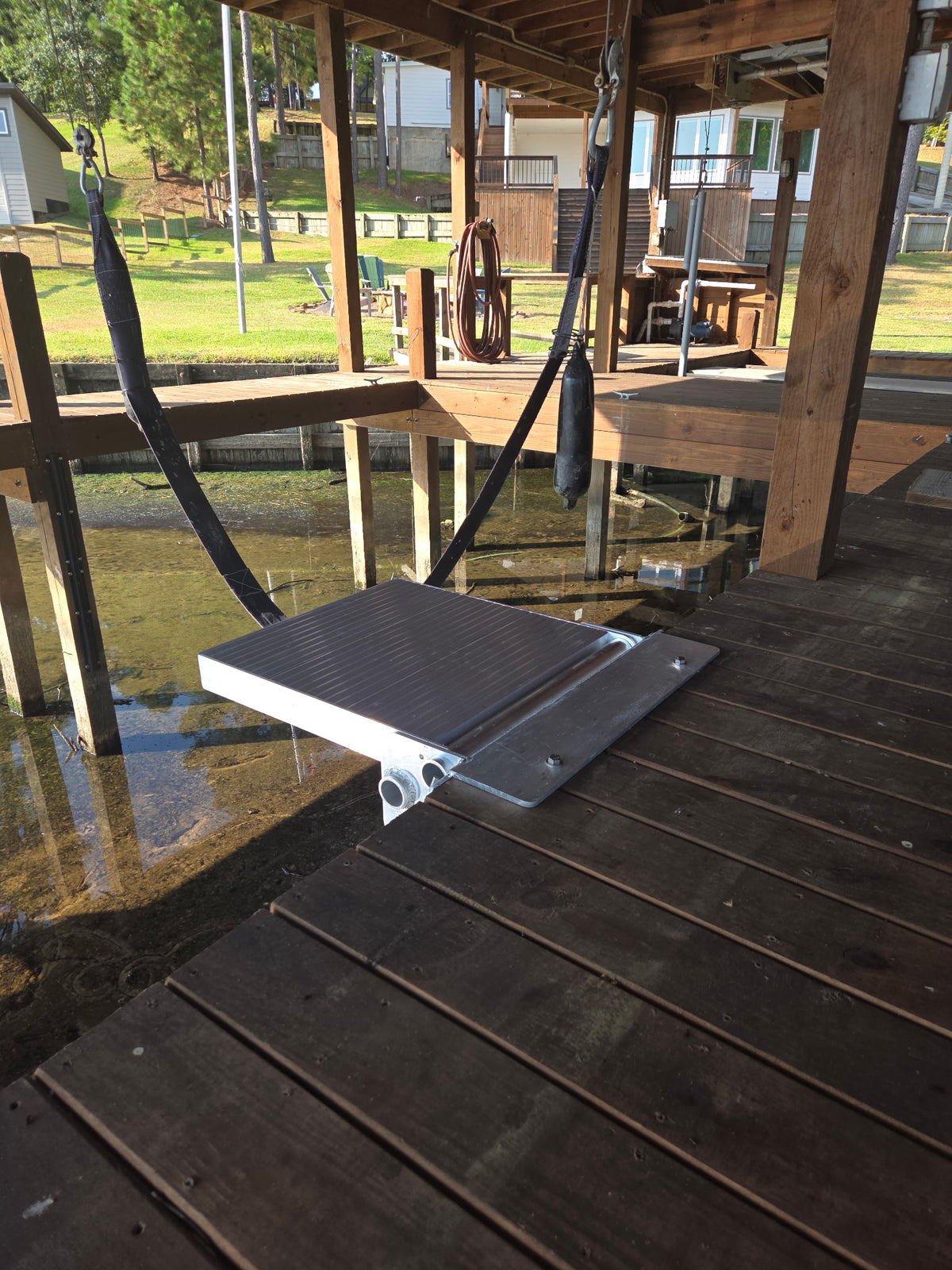
The gap between a fixed dock and a boat is where people slip. Folded down, the platform spans it with a solid aluminum deck at dock height, so nobody is stretching for the gunwale or stepping down into the boat.
When you are done it swings up against the dock, clear of lines, covers and anyone walking past. That is the whole point of a hinge: a fixed platform is always in the way of something.
Customer installation, East Texas. An angle mount in a covered boathouse, shown folded up and then down.
Flush or angle
Two ways to mount it
Same platform, same hinge, same six sizes, same price. One part tells them apart: the top mounting plate. Which one you want comes down to where your dock has solid structure to bolt into, and whether you mind a plate on the walking surface.

Flush mount
- Bolts to
- The vertical face of your dock: the rim beam on a wood dock, or the face of a concrete dock or seawall.
- On your deck
- Nothing. The walking surface stays completely clear to the edge.
- Pick it when
- Your dock face is solid enough to carry it, and you do not want anything to step over.

Angle mount
- Bolts to
- The dock face, as the flush mount does, plus a top plate that bolts down through the deck into the framing or the concrete.
- On your deck
- A 6 inch aluminum plate lying flat along the dock edge.
- Pick it when
- The top of the dock is where the solid structure is, or you want the exact configuration drawn on the engineer’s spec sheet.
Telling them apart in any photo: look for a plate lying flat on the decking. If there is one, it is an angle mount. Not sure which your dock takes? Look at where your dock has solid structure: a sound face takes the flush mount, solid decking and framing on top suits the angle mount.
Every size and what it costs
Two widths, three lengths each. Every size uses the same welded frame and hinge, and costs the same as a flush or an angle mount. Prices include freight to the continental US, and sales tax is calculated at checkout.
| Size | Width | Length | Price, freight included |
|---|---|---|---|
| 2 ft × 27-7/16 in | 24 in | 27-7/16 in | $1,135 |
| 2 ft × 35-7/16 in | 24 in | 35-7/16 in | $1,160 |
| 2 ft × 43-7/16 in | 24 in | 43-7/16 in | $1,205 |
| 3 ft × 27-7/16 in | 36 in | 27-7/16 in | $1,180 |
| 3 ft × 35-7/16 in | 36 in | 35-7/16 in | $1,225 |
| 3 ft × 43-7/16 in | 36 in | 43-7/16 in | $1,290 |
- *Length is how far the platform reaches out from your dock edge. Measure the gap from your dock edge to where you step aboard, and the height difference between them, before you choose a length.
- *Width is about traffic. The 2 ft is for one person stepping across. The 3 ft gives more room underfoot, so you can carry gear across without turning sideways. Cross one at a time.
- *Flush or angle mount, same price. The angle mount adds the top plate. Nothing else changes.
Why this costs more than a flip-up step
Search for a dock boarding step and you will find aluminum flip-ups for a few hundred dollars. They are a different object. Here is the straight comparison, so you can decide which one you actually need.
| Compare | Consumer flip-up stepTypical online listing | Hinged Boarding PlatformWhat we sell |
|---|---|---|
| WidthHow many people can cross at once. | Around 18 in | 24 or 36 in |
| Rated loadWhat the manufacturer publishes. | Around 325 lb | 60 PSF uniform, or 300 lb at the outside edge |
| StructureWhat carries you every time you step on. | Bolt-together | Welded 6061-T6, Schedule 80 pivot tube |
| EngineeringWhether anyone signed for the numbers. | None published | Sealed by a Florida licensed P.E. to 180 MPH |
| ShippingHow it gets to your dock. | Parcel | Freight, included in the price |
If one person stepping across alone is all you need, the cheaper step may genuinely be the right call. If anyone carries gear across, or if the person boarding is the one you worry about, the width and the engineering are what you are paying for.

Third-party engineering
Someone with a license put their seal on this
Most boarding steps sold online publish a weight and nothing else. This one comes with a specification sheet reviewed and sealed by a Florida licensed professional engineer, with the loads and the wind rating written down.
- Structural members are 6061-T6 aluminum unless noted otherwise
- Pivot and support tubes: Schedule 80, 2.375 inch round pipe
- Platform frame side plate: CS3 × 1.60 aluminum association channel
- Designed for a 60 PSF uniform load, or a 300 lb point load at the outside edge
- Ultimate wind speed 180 MPH, Exposure D, Risk Category I
- Florida Building Code 2020 (7th Edition), ASCE/SEI 7-16, ADM-2015
- Structural review sealed by J. L. Sanders, P.E., Florida Reg. No. 66361
The manufacturer states the platform should not be used during high wind events, and that site specific information decides whether additional bracing is needed. If your dock is unusually exposed, tell us before you order.
Frequently Asked Questions
The ones we get asked most. If yours is not here, ask us and we will answer it the same business day.
Which size do I need?
Two things decide it. Width is about traffic: the 2 ft is for one person stepping across, the 3 ft gives more room underfoot and for carrying gear. Cross one at a time. Length is set by the gap between your dock edge and where you step aboard.
The length in each size name is how far the platform reaches out from your dock edge. Measure the gap and the height difference between the dock and your boarding point before you choose a length.
What is the difference between a flush mount and an angle mount?
One part. Both use the same platform, hinge and vertical mounting plate on the dock face. The angle mount adds a top plate that bolts flat onto the top of the dock. The flush mount leaves it off, so nothing sits on your walking surface.
They cost the same. Pick the flush mount if your dock face is solid enough to carry it and you want the deck clear to the edge. Pick the angle mount if the solid structure is on top, or you want the exact configuration drawn on the engineer's spec sheet.
What can it mount to?
The specification sheet covers two connections: wood dock framing with decking, and a reinforced concrete dock or seawall. If yours is a floating dock or something unusual, ask us first.
Can I add a grab rail?
Yes. A grab rail can be added to the platform at extra cost, priced per foot of rail. It gives the person boarding something to hold on to while they step across, which matters most on a high dock or for anyone less steady on their feet.
The rail is not part of the standard configurations, so it is quoted rather than added to the cart. Tell us the platform size you are ordering and we will price the rail with it.
Are the fasteners included?
No, because the right fastener depends on what you are bolting into. The spec sheet calls for stainless steel throughout: 1/2 inch wedge anchors into concrete, and 1/2 inch thru-bolts plus 1/2 by 8 inch lag screws into wood framing.
Tell us what your dock is made of and we will tell you exactly what to buy.
How much weight will it hold?
It is designed for a uniform load of 60 pounds per square foot, or a 300 lb point load at the outside edge, per the manufacturer's sealed specification sheet.
Can it stay out in a storm?
The structure is designed for an ultimate wind speed of 180 MPH, Exposure D. The manufacturer also states it should not be used during high wind events, and that site specific information decides whether additional bracing is needed. If your dock is unusually exposed, tell us before you order.
How does freight delivery work?
Freight to the continental US is included in the price you see, so the number on this page is what you pay before sales tax. The platform ships direct from the manufacturer.
The carrier calls to schedule a delivery window and someone over 18 needs to be there to receive it. Inspect the crate before you sign: noting any damage on the delivery receipt is what makes a claim work. Photograph it and email us the same day and we handle the rest.
What is the warranty, and what if something is wrong?
Tell us what failed and send photos. We take it up with the manufacturer and stay on it with you until it is resolved.
Returns: we accept returns for shipping damage, manufacturing defects and our own errors, and in those cases we cover the cost. It ships by freight from the manufacturer, so we do not accept change-of-mind returns. Check the fit before you order.